
Longshore Worker Defeats ILA Bid to Exclude Him from Union’s Appeal of His NLRB Victory
ILA union attorneys tried to keep Stanford Fowler from participating in defending his own recent unfair-labor-practice victory against the union.
A Philadelphia-area longshore worker who won a substantial National Labor Relations Board (NLRB) remedy against International Longshoremen’s Association Local 1694 has now secured the right to participate in the federal appeal of that decision—over the union’s explicit objection.
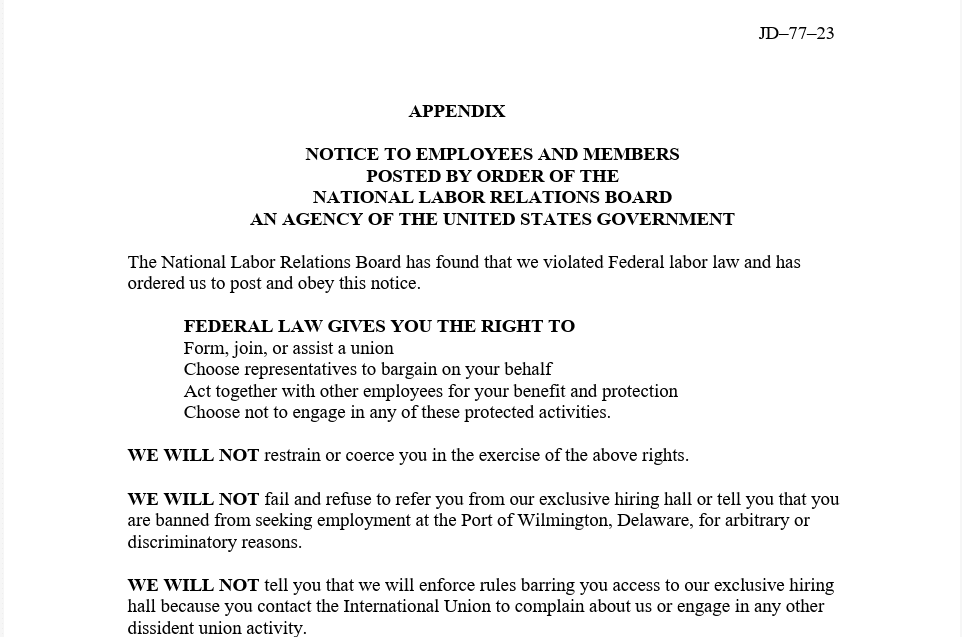
Stanford Fowler filed unfair-labor-practice charges after Local 1694 officials retaliated against him for contacting the international union’s secretary-treasurer about the local’s operations and a pending merger. An administrative law judge and a bipartisan NLRB panel found that the local had unlawfully blacklisted Fowler from its exclusive hiring hall, cost him years of work, and ordered five years of back pay. When the local appealed to the U.S. Court of Appeals for the Third Circuit, Fowler—assisted by National Right to Work Legal Defense Foundation attorneys—moved to intervene so that the party whose rights and financial recovery were at stake could be heard. The court granted the motion.
The episode is a concrete illustration of a recurring dynamic our Institute has documented for decades: once a union obtains exclusive control over job referrals, internal criticism can be met with economic sanctions that ordinary workers cannot easily contest. Fowler’s experience—confronted by local officials, excluded from the hall, forced to seek work at another port, and then told the very case he won should proceed without him—shows how the combination of monopoly bargaining status and hiring-hall authority can convert dissent into unemployment.
National Right to Work Foundation President Mark Mix observed that Fowler “raised common sense concerns regarding his treatment both before and after his original ILA Local was merged into another, yet rather than take his concerns seriously and treat him fairly, union bosses began a campaign of retaliation designed to prevent him from working to put food on the table.” The Foundation’s successful intervention motion ensures that the worker who proved the violations remains a party when the appellate court reviews the Board’s remedial order.
For researchers and policymakers tracking the practical operation of the National Labor Relations Act, the case raises a straightforward empirical question: when exclusive referral systems are insulated from effective internal challenge, how often do the statutory guarantees of Section 7 free speech and the duty of fair representation function as paper rights rather than enforceable protections? Fowler’s continued presence in the litigation will at least keep that question before the court of appeals.
Sources: National Right to Work Legal Defense Foundation release of July 27, 2026; NLRB Decision and Order in International Longshoremen’s Association Local 1694 (GT USA Wilmington, LLC), 374 NLRB No. 90 (2026).