
Georgia Right to Work Law Drives 17.7% Employment Growth—Why Does Sen. Ossoff Cosponsor the PRO Act to Undo It?
This post draws on National Right to Work President Mark Mix’s article on Right-to-work law has benefited Georgia. Why does Jon Ossoff want to undo it? in the AJC.
Georgia’s Right to Work Law Has Protected Choice and Spurred Growth for 79 Years
Nearly eight decades ago, Georgians secured a state Right to Work law so no employer could fire an employee for refusing to join or financially support a union. That principle remains in force today, shielding workers from compulsory dues while allowing those who freely choose union membership to do so. The National Institute for Labor Relations Research has long documented that Right to Work states typically experience faster growth in employment and disposable personal income than states that still permit forced-dues arrangements.
Employment Growth Data Underscores the Advantage
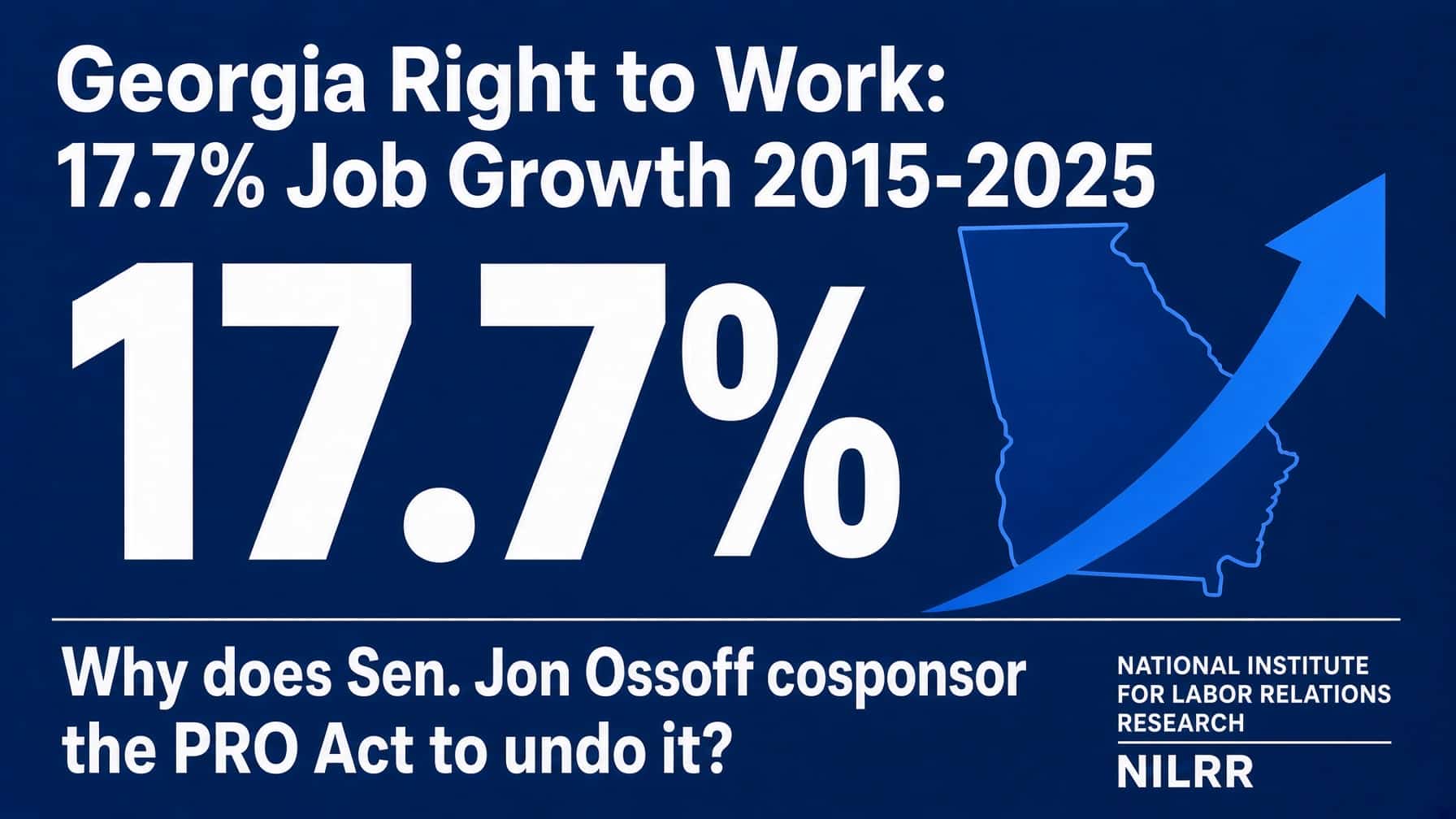
From 2015 to 2025, employment in Right to Work Georgia rose 17.7 percent—more than double the average among forced-dues states and higher than in any of the 24 remaining non-Right to Work states. Such outcomes align with broader NILRR analyses showing that employee choice correlates with stronger job creation. Academic observers have noted the trade-offs inherent in monopoly bargaining: as pro-union scholar Sheldon Leader observed, workers opposed to unionization are “often actually made worse off” under exclusive representation. Law professor Clyde Summers elaborated that seniority rules and wage structures negotiated by unions can disadvantage younger or higher-skilled workers. Even a 2015 Supreme Court brief signed by then-California Attorney General Kamala Harris and others acknowledged that monopolistic unionism grants officials “substantial latitude to advance bargaining positions that … run counter to the economic interests of some employees.”
The PRO Act Would Override State Right to Work Protections
Despite this record, U.S. Sen. Jon Ossoff (D-Ga.) has cosponsored the Protecting the Right to Organize (PRO) Act in every Congress since taking office. The legislation includes provisions that would nullify Georgia’s Right to Work statute and similar laws in every other state, restoring the forced dues as a condition of employment. In 2022, Ossoff also supported procedural changes in the Senate that would have eased passage of such measures. His Republican opponent, Rep. Mike Collins, has pledged full support for Right to Work. NILRR’s ongoing research and the National Right to Work Committee’s fact sheets continue to track how compulsory unionism affects individual workers and state economies.
Employee Choice Remains the Core Question
Georgia’s experience raises a straightforward policy question: if a state law protecting voluntary association has coincided with outsized employment gains, what rationale supports federal legislation that would remove that protection? Readers seeking the underlying data may consult NILRR’s Right to Work Benefits Fact Sheets, which compile Bureau of Labor Statistics and Bureau of Economic Analysis figures comparing job growth, income, and related metrics across Right to Work and non-Right to Work jurisdictions.
For free legal information on workplace rights under Right to Work principles, contact the National Right to Work Legal Defense Foundation.