
North Carolina: a model of economic freedom for employees and prosperity for NC
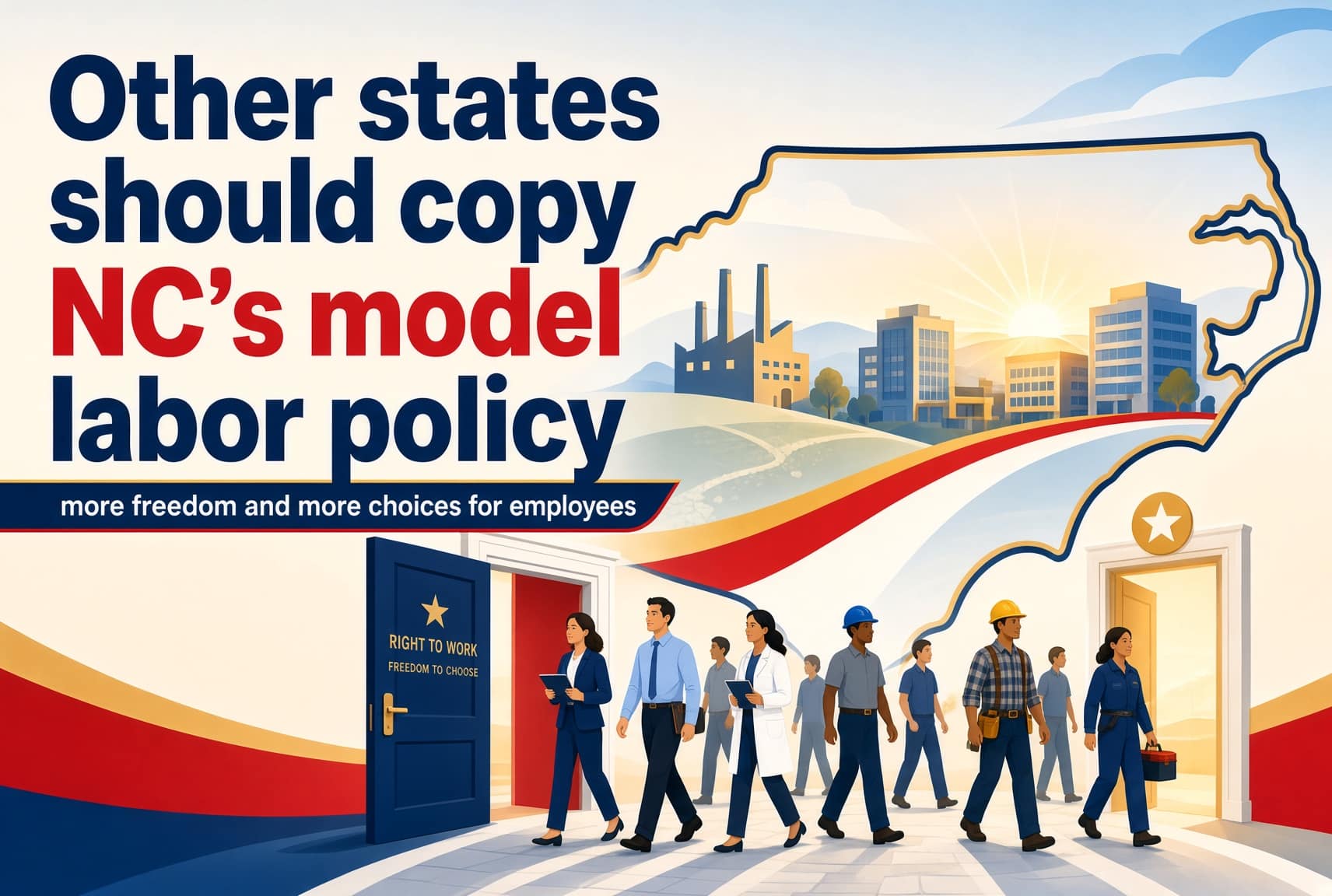
Other states should copy NC’s model labor policy
The debate over labor unions used to be about choice. One side said that joining a union should be as easy as possible to maximize an employee’s ability to choose a union. The other side said that the process should have guardrails so that people weren’t forced into a union they didn’t want. But both sides agreed that free choice was the goal.
In North Carolina, the law still reflects that idea. In both the public and private sectors, North Carolina protects employees’ right to choose. It gives private employees a right to opt out of union dues. And it protects public employees from having a union contract foisted on them. In effect, it respects choice by preventing coercion.
But elsewhere, public policy is moving in a different direction — a direction that sacrifices choice in favor of more union membership. The prime example is a recent proposal by academics at Harvard University, which would create a statewide system of “sectoral bargaining.” Sectoral bargaining is the opposite of choice: It funnels every employee in an industry into a single union, whether an employee voted for the union or not. The proposal’s premise is that unions are automatically good for workers, so workers should automatically be put into unions. Choice is beside the point.
This idea is no joke. It has already been picked up in several states. These states aren’t arguing along the old lines; choice is no longer center stage. But as other states decide whether to follow suit, they should first look to North Carolina. North Carolina shows what choice can do.
Choosing Prosperity
North Carolina’s labor policy has long been rooted in choice. In 1947, it became one of the first states to enact a “right to work” law, which allowed employees to opt out of mandatory union dues. And a decade later, it forbade public entities from entering collective-bargaining agreements with labor unions. That ban left public employees with the right to form and join labor unions: they could still assemble and speak on labor issues if they wanted to. But what they couldn’t do was force a collective-bargaining agreement on their coworkers — or the taxpayer.
The result has been prosperity. Since 1960, North Carolina has added GDP and jobs at a faster rate than the national average. It has attracted industries like manufacturing, banking, and research, all of which have swelled the state’s payrolls. It has also managed to balance its books while cutting taxes: Income taxes fell from 3.99% to 3.49% in the state’s latest budget. And through these developments, it has created an overwhelmingly attractive business environment, ranking first in CNBC’s 2025 rankings of the best states for business.
Narrowing the Options
Much of this prosperity has come at the expense of big Northern states, which have suffered an exodus of residents seeking friendlier environments. Given that experience, you might think that these states would study the North Carolina’s policies and try to emulate them. But not so. Rather than learn from North Carolina’s example, these states are doubling down on restraining choice.
The starkest example is “sectoral bargaining.” Sectoral bargaining is like collective bargaining but supersized: It groups every employee in an industry into a single bargaining union. This union is their “exclusive bargaining representative,” which means it negotiates their wages, hours, and working conditions. If they want different terms, tough luck. They have no way to negotiate their own deals, and they can’t get new terms by taking a different job. In sectoral bargaining, the union’s terms cover the whole industry. So the employer across the street has the same terms on offer.
Some states have already adopted limited forms of sectoral bargaining. Massachusetts, California, and Illinois already have it for rideshare drivers. But now, labor unions and their academic allies want to expand it to other sectors.
The Harvard proposal is case in point. The proposal would allow a union to ask a state board to certify it as an industry’s bargaining representative. And once the union is certified, it represents each employee in that industry — whether an employee asked for union representation or not. Essentially, the proposal aims to make every worker into a union member. Worker choice is irrelevant.
Of course, organizing a whole industry would be hard — maybe impossible using normal organizing methods. So to solve that problem, the Harvard proposal makes organizing easier. It says that if a union collects as few as 200 signatures, the union gets every employee’s personal contact information. And if the union then collects as few as 1,000 signatures, it can be certified as the exclusive representative — no election necessary.
That approach is an effective one if your goal is to get more people into unions. But it’s less effective if your goal is to let people choose for themselves. Since 1935, one of the main goals of national labor policy has been to give people “freedom of association” at work. The idea has been that people should choose for themselves whether to belong to a union or not. The same idea has long animated the law in North Carolina, which protects choice for public and private employees. But the Harvard proposal would toss choice aside. Its position is essentially that unions are automatically good for workers. So workers should be put into a union — they shouldn’t be allowed to choose otherwise.
For better or worse, that view is gaining steam. Labor unions, academics, and even lawmakers are opting for more restrictive labor laws. North Carolina long ago made the opposite choice, and it has reaped the benefits. The Harvard academics should take note.
This article first appeared on Carolina Journal.
