
Congress Sides with Union Bosses to Undermine Trump’s Executive Order on Federal Workforce Control
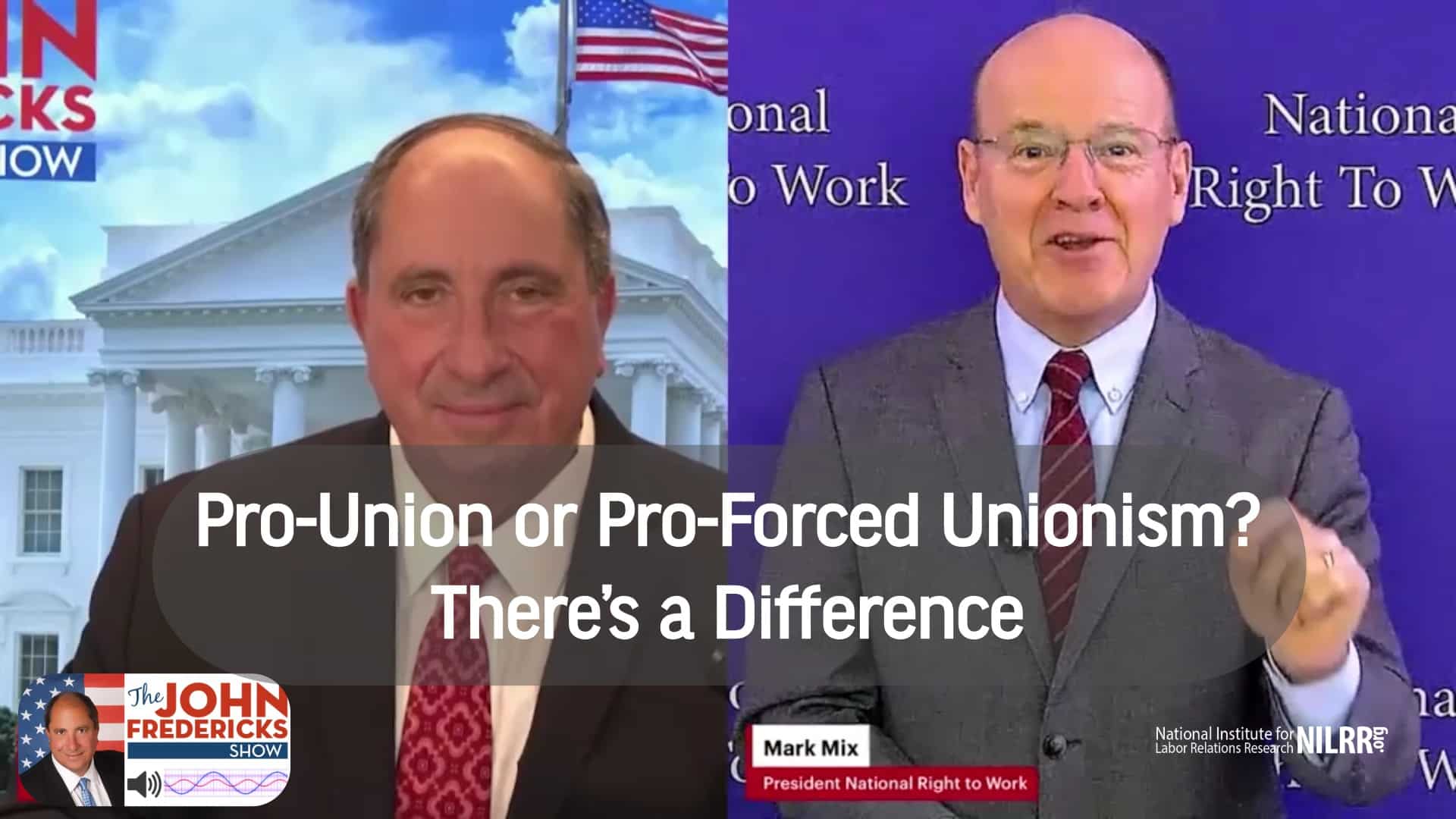
In a revealing discussion on the latest NILRR News Break, host John Fredericks speaks with Mark Mix, President of the National Right to Work organization, about a critical clash over presidential authority and government employee unions.
House Republicans joined Democrats in a surprising move to overturn President Trump’s Executive Order (EO) that restores management rights and limits union interference in federal agency operations. As Mark Mix explains, this EO reaffirms that the President — under Article II of the Constitution — holds ultimate authority over the federal bureaucracy, not union bosses.
Key highlights from the conversation:
- Federal unions’ monopoly power creates a dangerous intermediary between taxpayers and elected officials.
- Strikes by federal employees are illegal — a principle President Reagan enforced when he fired striking air traffic controllers.
- Many federal workers simply want to do their jobs without being forced into political activities or compelled to fund unions they never chose.
- There’s a vast difference between being pro-union and pro-forced unionism.
This episode underscores why voluntary unionism and worker freedom matter — especially in the public sector, where taxpayers ultimately foot the bill.
Watch the full discussion here: https://youtu.be/gSoOh5gf-MU
Stay informed on the fight against compulsory unionism and for Right to Work principles. Subscribe to our YouTube channel and follow NILRR for more updates!
— Issue Backgrounder —
Why the President Must Control Federal Employees: Defending Against Union Monopoly Bargaining in Government
In the ongoing battle for accountability in the federal workforce, President Donald J. Trump’s Executive Order 14251 stands as a critical step toward restoring presidential authority over government operations. (presidency.ucsb.edu) Issued on March 27, 2025, this order excludes numerous federal agencies and subdivisions from compulsory collective bargaining under the Federal Service Labor-Management Relations Statute (FSLMRS), emphasizing national security imperatives. (opm.gov) Yet, this necessary reform has faced fierce opposition from union officials, culminating in lawsuits like National Treasury Employees Union (NTEU) v. Trump. As of January 2026, the case remains pending in the U.S. Court of Appeals for the D.C. Circuit, with district court proceedings stayed. (clearinghouse.net and afge.org)
Our article explores the details of EO 14251, the NTEU v. Trump litigation, and the compelling reasons why the President—not private union bosses—must retain control over federal employees. Taxpayer-funded government should prioritize public service and national security, not union agendas that often hinder efficiency and accountability.
The Genesis of Executive Order 14251: Reasserting Presidential Authority
President Trump’s Executive Order (EO) 14251, titled “Exclusions from Federal Labor-Management Relations Programs,” builds on longstanding presidential powers under 5 U.S.C. § 7103(b)(1) and related statutes to exempt agencies primarily involved in national security work from union bargaining requirements. (congress.gov and epi.org) The order amends prior exclusions (dating back to Executive Order 12171 under President Carter) by designating over 40 agencies and subdivisions—such as parts of the Department of Defense, Justice, Homeland Security, the Cybersecurity and Infrastructure Security Agency, the Nuclear Regulatory Commission, FDA, CDC, and EPA—as ineligible for collective bargaining. (whitehouse.gov) This effectively terminates union recognition, negotiations, and grievance procedures for affected employees, allowing agencies to operate without the encumbrances of monopoly bargaining.
The rationale is clear: National security demands swift, unhindered decision-making. Union contracts can impose rigid rules that delay responses to threats or policy shifts. (healthequitypolicyhub.org) A follow-up order on August 28, 2025, extended these exclusions to additional units, like those in the Bureau of Reclamation, and adjusted deadlines for the Departments of Defense and Veterans Affairs. (akingump.com) The Office of Personnel Management (OPM) promptly issued guidance directing agencies to implement these changes, underscoring the administration’s commitment to streamlining government. (opm.gov)
Critics, including union bosses impacted by the change, such as those at the National Treasury Employees Union (NTEU), vaguely argue the order is overly broad and motivated by anti-union-control bias. (reuters.com) However, supporters see it as a vital correction to decades of expanding union influence, which has allowed unelected union officials to dictate terms in taxpayer-funded operations.
The Legal Challenge: NTEU v. Trump and Its Status
Filed on March 31, 2025, in the U.S. District Court for the District of Columbia (Case No. 1:25-cv-00935), NTEU v. Trump challenges EO 14251 as ultra vires and a First Amendment violation. (clearinghouse.net and taxnotes.com) The NTEU, representing thousands of federal employees, claims the exclusions improperly interpret “national security work” and aim to retaliate against unions for opposing administration policies. (tax.thomsonreuters.com) Potentially affecting up to 75% of unionized federal workers, the order is portrayed by plaintiffs as a tool for “mass firings” and political vengeance. (nteu.org)
Key milestones include:
- April 25, 2025: District Judge Paul L. Friedman granted a preliminary injunction blocking key sections of the order, citing likely irreparable harm to union bargaining power. (law.justia.com)
- May 6, 2025: The D.C. Circuit stayed the injunction pending appeal, deeming union harms speculative and emphasizing presidential national security discretion. (afge.org)
- June 2025: Cross-motions for summary judgment filed. (afge.org)
- December 15, 2025: Oral arguments in the D.C. Circuit (consolidated with related cases like American Foreign Service Association v. Trump), where judges expressed skepticism toward union claims. (reuters.com)
- December 22, 2025: District court stayed proceedings pending appellate decision. (afge.org)
- January 5, 2026: Supplemental briefing submitted; the case remains unresolved as of January 11, 2026. (clearinghouse.net)
Related suits, such as NTEU v. Trump (Case No. 1:25-cv-02990), which challenge exclusions for Patent and Trademark Office employees, are similarly stayed. (nteuchapter296.org)
Support from the National Right to Work Foundation: The Amicus Brief
The National Right to Work Foundation filed an amicus curiae brief on September 18, 2025, in the D.C. Circuit (Appeal No. 25-5157), staunchly defending EO 14251. (nrtw.org and nrtwc.org) The brief argues that Article II of the Constitution and the Civil Service Reform Act grant the President unreviewable authority to exempt agencies for national security reasons. (nrtw.org) It criticizes union “monopoly bargaining” for allowing officials to undermine administration goals, justifying broader exclusions. (nrtw.org) The Foundation urges reversal of the district court’s injunction, asserting that unions should not override presidential determinations funded by taxpayers. (nrtw.org) This aligns with broader critiques: Union bosses wield coercive power, forcing representation on unwilling employees and stifling government efficiency.
Complementary Reforms: Schedule F (Now Schedule Policy/Career)
EO 14251 dovetails with President Trump’s reinstatement of Schedule F via Executive Order 14171 on January 20, 2025. (whitehouse.gov) Renamed “Schedule Policy/Career,” it reclassifies policy-influencing positions as at-will, stripping due process protections for easier removals. (fedsupport.org and govexec.com) Affecting up to 50,000 roles, it combats bureaucratic resistance by ensuring employees “faithfully implement” policies without requiring personal endorsement. (opm.gov) OPM’s April 2025 proposed rules and November 2025 drafts label civil service protections as “unconstitutional overcorrections,” paving the way for final implementation in 2026. (public-inspection.federalregister.gov and govexec.com) Unions like NTEU have sued over Schedule F, but these reforms underscore the need for presidential control. (nteu.org and nteu.org)
Why Presidential Control Matters: The Case Against Union Bosses in Government
The core issue is simple: Federal employees serve the public under the President’s direction, not private union contracts that prioritize union interests. (nrtw.org)
Here’s why this is paramount:
- National Security and Efficiency: Unions can block rapid policy changes, as seen in resistance to Trump’s agenda. EO 14251 ensures security-focused agencies operate without such interference. (epi.org)
- Taxpayer Accountability: Government is funded by taxpayers, not union dues. Monopoly bargaining allows unions to negotiate perks that inflate costs and reduce productivity, as evidenced by NILRR research showing Right to Work states’ superior job growth and incomes. (nilrr.org)
- Preventing Union Abuse: Reports of union official misconduct—embezzlement, fraud—highlight risks when unions hold sway over public operations. (nilrr.org) Federal employees should not be coerced into unwanted representation.
- Democratic Mandate: Voters elect the President to lead; unions subvert this by entrenching opposition within bureaucracy. (nrtw.org)
Without these reforms, union bosses could continue to “stymy” executive priorities, as noted in the NRTW brief. (nrtw.org) Upholding EO 14251 and Schedule Policy/Career is essential for a responsive, accountable government.
In conclusion, NTEU v. Trump represents a pivotal fight against entrenched union power. By supporting presidential authority, we protect national security, honor taxpayer dollars, and ensure government serves the people—not special interests. The courts should affirm these executive actions, paving the way for a more efficient federal workforce.
Footnotes:
For detailed sources, refer to the inline citations above, drawn from court documents, official releases, and analyses. Key references include:
- Civil Rights Litigation Clearinghouse entries on NTEU v. Trump.
- White House and Federal Register publications for EO 14251 and 14171.
- NRTW Foundation press releases and briefs.
- OPM guidance and proposed rules.
- NILRR fact sheets on Right to Work benefits.
This article draws on Grok.com research, publicly available legal, and policy documents as of January 11, 2026.
Key Takeaways
- Host John Fredericks discusses President Trump’s Executive Order with Mark Mix, focusing on federal unions and presidential authority.
- House Republicans and Democrats oppose the Executive Order that limits union influence in federal operations.
- The National Treasury Employees Union challenges the Executive Order in court, claiming it violates the First Amendment.
- Supporters of the Executive Order argue that it prioritizes national security and taxpayer accountability over union interests.
- The article emphasizes the need for presidential control in federal employment to ensure efficient governance and national security.
For updates, visit NILRR.org and NRTW.org.