

Unions at a Crossroads: New Data Confirms a Quarter Century of Decline—and Points the Way
For more than 75 years, American unions have been in steady retreat. The latest evidence, meticulously documented in Rachel Greszler’s new report from the Plymouth Institute for Free Enterprise, “A Quarter Century of Union Decline, 2000 to 2025,” confirms what workers and employers have long observed: forced-unionism models are increasingly out of step with today’s merit-based, service-oriented, and globally competitive economy.
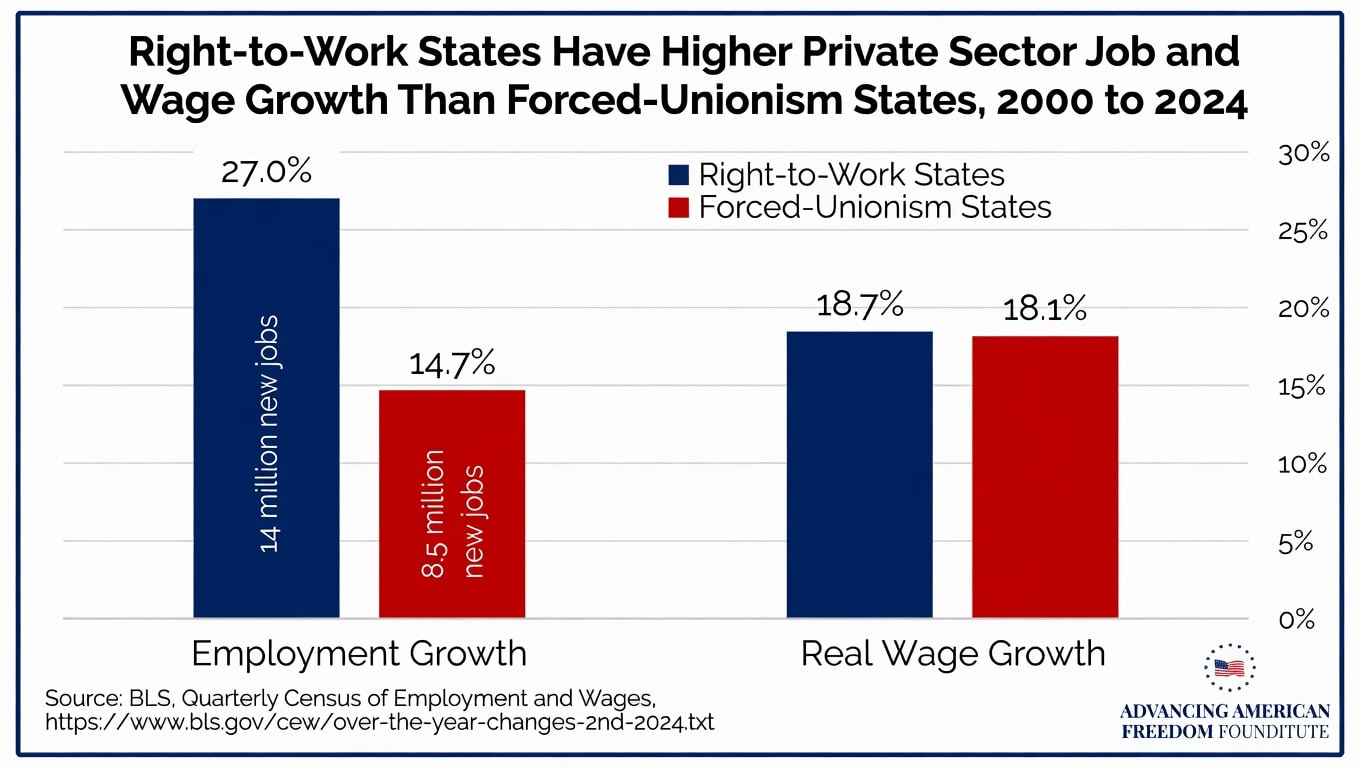
Perhaps most compelling is the right-to-work comparison. States that protect workers’ freedom to choose whether to join or pay a union have added 14 million private-sector jobs since 2000—a 27 percent gain—versus just 8.5 million jobs (14.7 percent) in forced-unionism states. Real private-sector wage growth was also stronger in right-to-work states (18.7 percent versus 18.1 percent). These are not marginal differences; they represent hundreds of thousands of families with better opportunities and higher living standards precisely because workers cannot be coerced into unwanted union membership.
Greszler’s most valuable contribution may be her forward-looking recommendations. The modern workforce, she argues, is ill-suited to one-size-fits-all contracts. Forced representation strips individual workers of their voice and leaves non-members subject to terms they never agreed to. The real solution is purely voluntary bargaining: unions that compete for members by offering pooled health insurance, continuing education in high-demand fields such as advanced manufacturing and artificial intelligence, or limited-service representation akin to major-league sports associations. Such models would eliminate “free-rider” complaints while empowering workers to negotiate what truly matters to them.
Greszler’s analysis, drawn directly from Bureau of Labor Statistics data released just weeks ago, shows union membership nationwide stood at 10.0 percent in 2025—down 3.4 percentage points since 2000 and only a hair above the all-time low of 9.9 percent recorded in 2024. The private sector, the engine of American job creation, remains stuck at a record-low 5.9 percent. Even the modest uptick last year was driven entirely by government workers, whose unionization rate rose to 32.9 percent. Private-sector unionization, by contrast, has fallen 3.1 percentage points over the same period.
These numbers are not abstract. They reflect real choices by millions of American workers who, when given the freedom to decide, increasingly opt out of compulsory union representation. As Greszler notes, rigid seniority-based pay scales that made sense in 1950s factories feel outdated to today’s specialized, mobile workforce. Adversarial tactics that pit workers against employers ignore the shared interest both sides have in a thriving enterprise.
The earnings story is equally revealing. Union jobs have historically paid more, but that premium has narrowed dramatically—from 21.4 percent in 2000 to just 16.4 percent in 2025—as non-union wages grew faster. Recent big-ticket union contracts have temporarily reversed that trend in some sectors, yet the results have been painful: the United Auto Workers’ deal with the Big Three automakers has coincided with the loss of 72,800 motor-vehicle and parts jobs; the International Longshoremen’s Association contract has been followed by 5,600 fewer jobs in support activities for water transportation. Above-market wage mandates, it turns out, often price workers out of jobs.
Greszler’s sector-by-sector breakdown further dismantles the claim that unionization drives prosperity. Goods-producing industries have seen the sharpest drops in union density, while service sectors have held steadier or even posted modest gains. Yet there is “no clear correlation” between changes in unionization rates and real wage growth. Healthcare and social services, leisure and hospitality, manufacturing, and utilities—all among the leaders in real-wage gains—ranked second- and third-lowest or second- and third-highest in unionization declines. The data simply do not support the narrative that forced collective bargaining is the secret to higher pay.
Demographic trends tell a similar story of adaptation and choice. Younger workers (ages 16–24) saw a small uptick to 4.7 percent unionization in 2025, yet they still comprise only 6.1 percent of union members. Union rolls have grown slightly younger, whiter, and more female overall, while older, male, and Black workers have experienced the steepest long-term declines—precisely the groups once thought to be unionism’s core base.
At NILRR, we have spent decades documenting the real-world consequences of compulsory unionism—lost jobs, reduced mobility, and coerced political spending. Greszler’s report provides fresh, authoritative confirmation that right-to-work laws deliver higher employment and stronger wage growth without sacrificing worker voice. Employers who listen to their employees thrive; those who rely on forced unionization fall behind.
Outside of government, private-sector unionization remains at historic lows. The long-term decline is unlikely to reverse unless unions themselves adapt—by embracing voluntary membership, less adversarial relations, and services workers actually want. Greszler’s data-rich analysis should be required reading for policymakers, union leaders, and anyone who cares about expanding opportunity for American workers. The evidence is clear: freedom to choose works. Forced unionism does not.
Read Rachel Greszler’s full report at Advancing American Freedom.
The National Institute for Labor Relations Research is a nonprofit organization dedicated to the right of workers to choose whether to join or financially support a union.