
Beware of the Dark Side of Union Hiring Halls
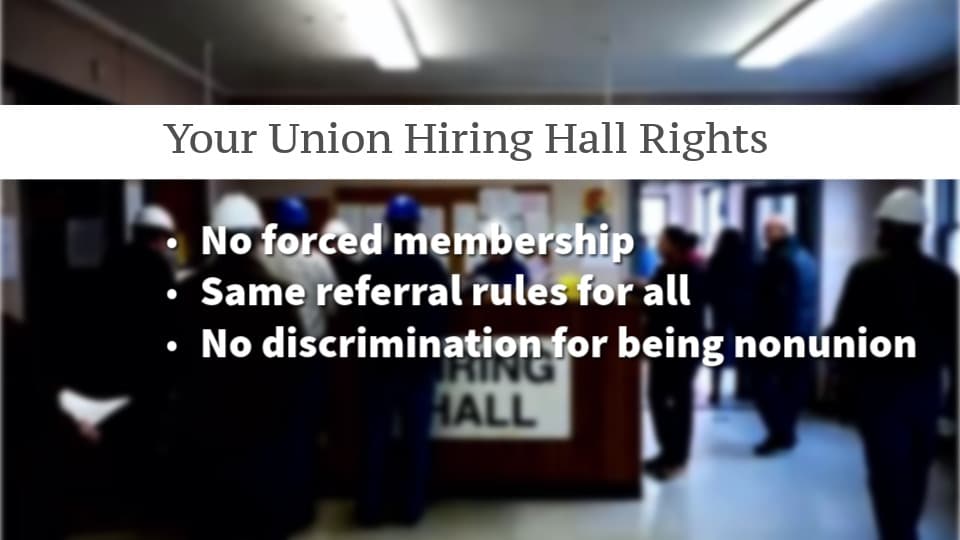
Independent nonunion workers are right to be wary when a union hiring hall controls who gets referred to jobs. The Dark Side of Union Hiring Halls video provides real stories of that risk, particularly focusing on the ongoing case of IUOE Local 926 versus Dennis Taylor & Co. workers Michael Mitchem, Billy Johnson, Chris Oaks, John Stroh, and David Johnson.[1][2][3]
When the “jobs list” becomes a weapon
In theory, a union‑run hiring hall should be nothing more than a central list that matches workers with employers. In reality, when the hiring hall is “exclusive”—meaning the employer agrees to hire only workers referred from the union’s list—that list often becomes a powerful weapon against nonunion workers.[4][1]
As the National Right to Work Legal Defense Foundation (NRTW) explains, you cannot legally be forced to join a union just to use an exclusive hiring hall, and the union must apply the same neutral referral rules to members and nonmembers. But union officials “sometimes discriminate against nonmembers” in referrals, and those workers are invited to contact NRTW for legal aid with this injustice.[5][1]
Learn more: NRTW’s hiring hall rights page – https://www.nrtw.org/rights-hiring-hall-private/[1][5]
Recent Example Case: IUOE Local 926 fines for just going to work
The Dennis Taylor & Co. case in Georgia shows how abusive this power can become once union bosses decide nonmembers are a problem. Dennis Taylor & Co. used to take employees through an IUOE Local 926 hiring hall, but the company later ended that arrangement and hired directly. After that change, several workers—including Mitchem, Billy Johnson, Chris Oaks, John Stroh, and David Johnson—resigned their IUOE memberships and stayed on the job with the nonunion contractor.[2][3]
Months and even years after those resignations, IUOE Local 926 officials sent letters threatening “internal discipline” and fines, apparently because the workers continued to work for Dennis Taylor & Co., which had once been part of a hiring hall arrangement but is not anymore. The workers responded by filing federal charges at the National Labor Relations Board (NLRB), with free legal aid from NRTW, alleging illegal post‑resignation discipline.[3][2]
Read the case releases:
- October 21, 2025 NRTW release – “Heavy Equipment Operators File Federal Charges Against Operating Engineers Union for Illegal Retaliation.” https://www.nrtw.org/news/georgia-dennis-taylor-co-iuoe-10212025/[2]
- January 9, 2026 release – “Two Additional Heavy Equipment Operators Targeted By Operating Engineers Union Bosses File Federal…” https://www.nrtw.org/news/georgia-dennis-taylor-co-iuoe-01092026/[3]
Key warning signs for nonunion workers
If you’re a nonunion worker dealing with a hiring hall—or an employer that uses one—watch for these red flags:
- “No card, no job” pressure: Being told, explicitly or implicitly, that you must join the union or sign a dues checkoff to get referred. That conflicts with your right under federal law to refrain from membership, even in an exclusive hiring hall.[1][5]
- Different rules for nonmembers: Referral lists that always seem to favor union loyalists, unexplained delays or skipped referrals, or “informal” rules that just happen to shut you out.[1]
- Post‑resignation threats: Letters or calls threatening “internal union discipline” or fines simply because you resigned but kept working for a company that once used a union hiring hall, as in the IUOE Local 926 case.[3][2]
- Forced or excessive fees: Demands for hiring hall “fees” that look like full union dues—especially in Right to Work states, where compulsory union payments are heavily restricted, and hiring‑hall fees are a “disputed and complicated” issue.[6][1]
For a clear overview of these issues in plain language, NRTW’s hiring‑hall FAQ is a good starting point: https://www.nrtw.org/rights-hiring-hall-private/[5][1]
What to do if you’re facing hiring hall abuse
NRTW’s guidance is consistent: do not ignore the problem and do not assume the union’s version of your rights is accurate. Instead:[7][1]
- Document everything: Keep copies of all letters, emails, and text messages from union officials or employers. Write down dates, times, and what was said in conversations about referrals, membership, or fines.[2][1]
- Learn your rights: NRTW’s “About Your Legal Rights: Private Sector Employee” hub pulls together explanations of hiring hall rights, resignation rights, dues objections, and more: https://www.nrtw.org/your-rights-private/[8][7]
- Request free legal aid: If you believe you are facing hiring hall discrimination or illegal post‑resignation discipline, you can submit a confidential request for help through NRTW’s online form at https://www.nrtw.org/request-free-legal-aid/. The Foundation explicitly lists “abuses of exclusive hiring halls” as an area where its staff attorneys may take cases.[9][1]
The Dennis Taylor & Co. workers’ charges were filed at the NLRB with help from the National Right to Work Legal Defense Foundation’s legal team. If your situation looks similar—pressure tied to a hiring hall, retaliation after resignation, or threats of fines just for working—your next step should be to understand your rights and, if appropriate, get legal help before any deadlines pass.[4][3][2][1]
Endnotes
- National Right to Work Legal Defense Foundation, “What are my rights if I must obtain work through a union hiring hall?” (Hiring hall rights overview, including nonmember protections and fee issues), available at: https://www.nrtw.org/rights-hiring-hall-private/[5][1]
- National Right to Work Legal Defense Foundation, “About Your Legal Rights: Private Sector Employee” (gateway page to hiring hall, resignation, and dues information), available at: https://www.nrtw.org/your-rights-private/[7][8]
- National Right to Work Legal Defense Foundation, “Heavy Equipment Operators File Federal Charges Against Operating Engineers Union for Illegal Retaliation” (Dennis Taylor & Co. IUOE Local 926 case, initial charges), October 21, 2025, available at: https://www.nrtw.org/news/georgia-dennis-taylor-co-iuoe-10212025/[2]
- National Right to Work Legal Defense Foundation, “Two Additional Heavy Equipment Operators Targeted By Operating Engineers Union Bosses File Federal…” (follow‑up on additional workers Stroh and Johnson), January 9, 2026, available at: https://www.nrtw.org/news/georgia-dennis-taylor-co-iuoe-01092026/[3]
- National Labor Relations Board, “Hiring Halls” (overview of legal standards for union‑run referral systems and workers’ rights), available at: https://www.nlrb.gov/about-nlrb/rights-we-protect/the-law/employees/hiring-halls[4]
- National Right to Work Legal Defense Foundation, “Request Free Legal Aid” (online intake form for workers facing abuses of exclusive hiring halls and other compulsory unionism issues), available at: https://www.nrtw.org/request-free-legal-aid/[9]
- National Right to Work Committee, “What Does Right to Work Mean?” (basic explanation of Right to Work protections and limits on compulsory union payments), available at: https://nrtwc.org/facts/right-work-mean/[6]
Key Takeaways
- Nonunion workers should be cautious of union hiring halls, as they can lead to biased job referrals.
- The case of IUOE Local 926 demonstrates how union control can result in fines for workers who choose to work nonunion jobs.
- Workers have rights under federal law to refrain from union membership even when using exclusive hiring halls.
- If facing hiring hall discrimination or retaliation post-resignation, document incidents and seek legal aid from NRTW.
- Watch for warning signs like pressure to join a union, different rules for nonmembers, and threats of internal discipline.