

How the ILA Union Bosses Shut Down South Carolina’s Brand-New, Taxpayer-Funded Hugh K. Leatherman Sr. Terminal for Years
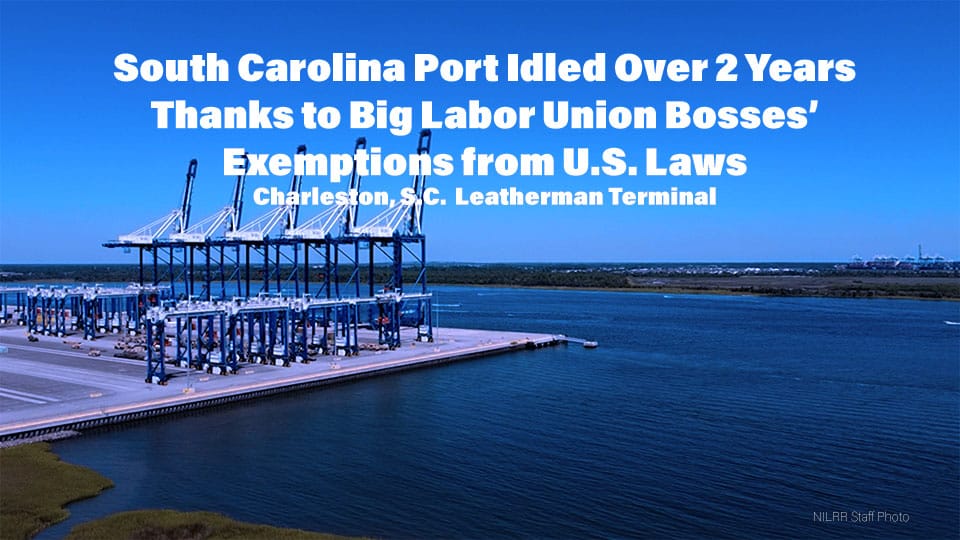
A Textbook Example of NLRA-Imposed Compulsory Unionism & Monopoly Control Over Individuals
The Hugh K. Leatherman Sr. Terminal in Charleston, South Carolina, stands as one of the clearest demonstrations of how the International Longshoremen’s Association (ILA), armed with National Labor Relations Act (NLRA) privileges, can effectively paralyze a modern, state-built, and state-operated public port. What should have been a $1 billion (ultimately about $1.5 billion) economic engine adding massive new container capacity was turned into a near-ghost facility for more than three years after its 2021 opening — not by a strike, not by weather, not by market forces, but by the ILA Union’s coast-wide master contract, exclusive representation rights, and the legal shield of the NLRA’s monopoly-control mechanisms and forced-union-dues structure.(1,2)
Right to Work South Carolina Tries to Compete for Business
South Carolina Ports Authority (SCPA) — a public agency in a Right to Work state — designed and funded the Leatherman Terminal to handle larger neo-Panamax vessels, add up to 2.4 million shipping containers of annual capacity, and boost exports from a manufacturing-heavy state. Phase One opened in March 2021 with advanced ship-to-shore cranes, hybrid rubber-tired gantry cranes, and near-dock rail.(3)
SCPA deliberately used its proven hybrid labor model that had operated successfully for years at the state’s other two terminals (Wando Welch and North Charleston):
- ILA-represented private contractors handled traditional longshore work (loading/unloading on the dock).
- Non-union state employees operated the high-tech cranes and lift equipment.
This model kept labor costs competitive, avoided forced union dues for public employees, and delivered reliable service. No one disputed that ILA members already performed the majority of work. The state simply refused to hand over every new job at a brand-new terminal to the union monopoly.
How the ILA Shut It Down: Union Master Contract Plus an NLRA-Enforced Cartel Power
The ILA did not need to picket or strike the public port directly. Instead, its legal team weaponized its coast-wide master contract with the United States Maritime Alliance (USMX — the multi-employer group of ocean carriers) under NLRA protections:(4)
- The Contract Clause: Section 7(b) of the ILA-USMX Master Contract (and related provisions in the Containerization Agreement) required that all longshore work at newly constructed terminals be performed exclusively by ILA bargaining-unit members. They argued that this included crane operations that the ILA had never performed at Charleston’s older terminals.(5)
- The Lawsuit: Shortly after the first USMX carrier ships called at Leatherman in April 2021, the ILA (and Local 1422) sued the carriers and USMX in New Jersey state court for alleged breach of the master contract — seeking $300 million in damages. The suit was not against the public Ports Authority but against the private carriers.(6)
- The Secondary Boycott in Practice: Facing contract penalties and ILA pressure, USMX carriers immediately stopped calling at Leatherman. Ships were redirected to other terminals or even to competing ports, such as Savannah, Georgia. By early 2023, the terminal was effectively fully idled — a brand-new, taxpayer-funded facility handling almost no cargo while the rest of the port continued operating under the hybrid model.
- NLRA and Courts Rubber-Stamp the Monopoly:
- a. The Biden NLRB ruled 2–1 for the ILA on December 16, 2022, declaring the lawsuit and master-contract enforcement lawful “work preservation” activity — not an illegal secondary boycott.(7)
- b. The U.S. Court of Appeals for the Fourth Circuit upheld the NLRB 2–1 on July 28, 2023.(8)
- c. The U.S. Supreme Court declined to hear South Carolina’s appeal on February 20, 2024, ending the legal fight.(8)
This was not market competition or worker choice. It was NLRA-enabled monopoly control: exclusive representation rights, multi-employer master contracts, and the “work preservation” doctrine that gave the ILA veto power over a public port’s labor model. In non-right-to-work states, the same structure extracts forced union dues; here, the union monopoly simply blocked non-union state employees from getting jobs at the port.
The Economic Harm: Billions Squandered, No Benefit to Workers or Consumers
- A $1-$1.5 billion public investment was idled for years.
- South Carolina lost tens of millions in port revenue, jobs, and export capacity.
- Shippers and manufacturers rerouted cargo, raising costs and delays.
- Non-union state crane operators (hundreds of jobs) faced displacement threats.
Only the ILA gained: it extracted total jurisdiction over the State’s new terminal as the price of reopening.
The June 2024 Settlement and Reopening
After the Supreme Court loss, SCPA and the ILA reached a settlement in June 2024. The terminal reopened in September 2024 under an all-ILA model for crane operations (state workers could transfer to union status or stay non-union at other terminals). The dispute had lasted more than three years from opening — effectively shutting down operations with almost three years of full idling.
scspa.com
The Broader Lesson: This Is NLRA Monopoly Power and Forced Dues in Action
The ILA did not “shut down” the terminal with picket lines. It used the NLRA’s grant of exclusive bargaining rights, coast-wide master contracts, and antitrust-exempt “work preservation” rules to force private carriers to boycott a public facility — all while the union continues to collect forced dues elsewhere to sustain its cartel. No other industry could lawfully exercise this power over interstate commerce choke points.
This is precisely why targeted NLRA reform — banning hiring-hall monopolies, ending monopoly bargaining, passing the National Right to Work Act to end compulsory dues at critical infrastructure, limiting master contracts at public ports, and restoring antitrust limits — is essential. Until Congress acts, the ILA and ILWU unions will continue using federal labor law to idle taxpayer assets, inflate costs, and impose America’s largest internal tariff on every American consumer and exporter.
The Leatherman Terminal saga helps prove that the current NLRA status quo is indefensible.
NOTE: How is the South Carolina Port today?
Post and Courier (April 5, 2026): “SC’s $1.2B port terminal is a financial drain. Work is underway to plug the leak.” The article details how the Leatherman Terminal remains underused compared to the Wando Welch Terminal, largely due to higher operating costs from the all-union workforce following a 2024 labor dispute resolution (including a U.S. Supreme Court decision favoring the ILA). New CEO Micah Mallace is working with partners (including the union) to address the cost structure, amid broader port efforts to boost growth during a shipping downturn. Lawmakers like Sen. Larry Grooms have pressed for fixes.(9)
Key Takeaways
- The Hugh K. Leatherman Terminal became inactive after the ILA used NLRA protections to assert control, despite its potential as a $1.5 billion economic asset.
- South Carolina Ports Authority’s hybrid labor model was thwarted by the ILA’s master contract, preventing the use of non-union state workers at the terminal.
- The NLRA allowed the ILA to enforce a boycott on the terminal, which resulted in significant financial losses and cargo delays for South Carolina.
- A settlement in June 2024 forced the terminal to operate under an all-ILA model, demonstrating the power of union monopoly in public ports.
- The case underscores the need for NLRA reform to prevent forced dues and monopolistic practices affecting taxpayer-funded facilities.
Footnotes
- South Carolina State Ports Authority v. NLRB (4th Cir. 2023) – full opinion: https://law.justia.com/cases/federal/appellate-courts/ca4/23-1059/23-1059-2023-07-28.html
- National Right to Work Foundation coverage and background: https://www.nrtw.org/newsletter-articles/port-of-charleston-leatherman-nlrb-08222023/
- ILA lawsuit details (April 2021): https://gcaptain.com/ila-union-lawsuit-claims-breach-of-master-contract-at-new-terminal-at-port-of-charleston/
- Master Contract Section 7(b) text and analysis: see SCSPA Petition Appendix (U.S. Supreme Court Docket No. 23-325) ILA-USMX Master Contract, Article VII, Section 7(b). ILA Union Lawsuit Claims Breach of Master Contract at New U.S. Terminal
- NLRB Decision (Dec. 16, 2022) referenced in 4th Circuit opinion, see footnote (3).
- Fourth Circuit 2-1 decision (July 28, 2023): https://law.justia.com/cases/federal/appellate-courts/ca4/23-1059/23-1059-2023-07-28.html.
- U.S. Supreme Court denies certiorari (Feb. 20, 2024): https://www.southcarolinapublicradio.org/sc-news/2024-02-20/us-supreme-court-votes-against-hearing-leatherman-terminal-labor-dispute
- SC Ports & ILA Settlement announcement (June 25, 2024): https://scspa.com/news/sc-ports-moving-forward-with-ila-to-reopen-leatherman-terminal/
- Post and Courier (April 5, 2026): https://www.postandcourier.com/business/industry/sc-ports-charleston-leatherman-terminal/article_c6a0a4b9-33ad-4405-8036-9de6e6cfc211.html
Estimated reading time: 6 minutes