

Union Bosses Admit They Spent $1.8 Billion on Politics in the 2024 Election Cycle — The Real Number is Likely Over $28 Billion
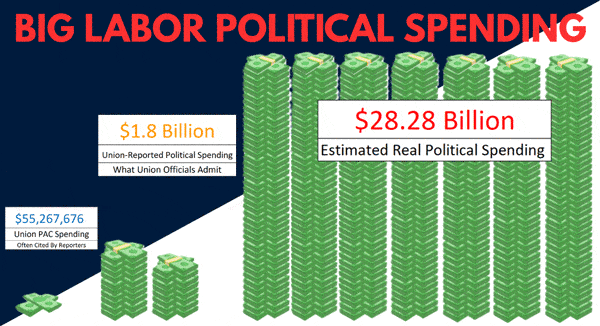
Union-reported political spending from union dues-funded treasuries was up 8% since the last cycle.
Click here to download a complete copy of the report
December 18th, 2025 – Just 6 percent of American private-sector workers belong to a labor union, yet unions are a dominant political force. By their own admission, union officials spent over $1.8 billion on politics during the 2023-2024 election cycle.
That’s over $130 Million more than they reported spending in the previous cycle, and it’s far more than what’s typically reported by media outlets that only consider spending by union-controlled political action committees (PACs). But a new analysis by the National Institute for Labor Relations Research (NILRR) shows that even public filings don’t tell the whole story.
The study shows that the vast majority of what unions spend to influence elections and policymaking is not reported to the federal government as political contributions to candidates or committees. Some expenditures are improperly labeled as “grants” or “general overhead.” Others are tucked away in the budgets of smaller union affiliates that aren’t required to file full financial disclosures.
However, the bulk of unreported political power is wielded by government union officials. They’re armed with the monopoly power to negotiate salaries, pensions, and hiring practices for entire swaths of federal, state, and local government workers. This makes monopoly bargaining in the public sector, by its very nature, political.
Public sector unions exist solely to change government employment policies. They have legal leverage over the policy process that other political groups do not have, such that the money spent on staffing, organizing, and promoting government-sector unions has a more direct impact on politics than other groups spend to persuade voters.
When we take into account all the inherently political money spent by public sector unions, Big Labor’s true total political spending for the 2023-2024 political cycle was over 28 billion dollars.
The PAC Distraction
Union-controlled Political Action Committees, or “PACs” spent $55,267,676 in the 2024 election cycle, according to political spending watchdog OpenSecrets.
Media reports often include only PAC spending, or other relatively small buckets of union spending that get reported to the Federal Election Commission. But most large unions are required to file forms to the Department of Labor that disclose exactly how much of their spending from forced-dues-funded general treasury funds was political.
What Union Officials Admit Spending on Politics
Private-sector unions and many public-sector unions that bring in more than $250,000 each year must file the Department of Labor’s Form LM-2, which breaks down annual expenditures into different categories. The information is provided by labor union officers who must file union disclosure reports and attest to their veracity. Under the Labor-Management Reporting and Disclosure Act of 1959, As Amended, officers are subject to criminal penalties for willful failure to file a required report and for false reporting.
NILRR staff used totals from SCHEDULE 16–POLITICAL ACTIVITIES AND LOBBYING, found in the LM-2 reports for the filing years 2023 and 2024. These were accessed on the U.S. Department of Labor’s Office of Labor-Management Standards website: https://www.dol.gov/agencies/olms (Downloaded 9/22/2025).
In 2023 and 2024, unions reported spending $1,746,422,504 on politics and lobbying on the LM-2, an 8% increase from the reported total of $1.61 billion in 2021 and 2022.
A significant source of funding for reported Schedule 16 activities is union dues and fees collected from men and women who would be fired for refusing to pay. Adding back the PAC spending that isn’t included on the LM-2, the total reported political spending by unions is over $1.8 billion.
What Big Labor Officials Conceal
Schedule 16 activities are often underreported because union officials put clearly political expenses in other categories, including “Representational Activities,” “Contributions, Gifts, and Grants,” “General Overhead,” and “Union Administration.”
Here are just a few examples of LM-2 disclosures that should have been reported as political spending, but were not:
• The NEA gave a total of $9,500,000 in 2023 and 2024 to the State Engagement Fund, a left-of-center 501(c)(4) advocacy organization.
• The International Brotherhood of Carpenters and Joiners of America gave $4,750,000 to the Strategic Victory Fund, which InfluenceWatch.org describes as a fund “created to support Democrat causes on state-level issues in battleground states.”
• The International Brotherhood of Electrical Workers gave $5,000,000 to “Development Now for Chicago” the official “Host Committee” affiliated with the 2024 Democratic National Convention in Chicago. The Carpenters Union and LIUNA each gave $1 million, which, like the IBEW contribution, were categorized as “Contributions, Gifts and Grants.” Meanwhile, ten other unions correctly categorized their payments (totaling over $10 million) to “Development Now for Chicago” as political.
• The Service Employees International Union gave $5,500,000 to The Fairness Project and reported it under “Contributions, Gifts and Grants.” InfluenceWatch.org describes The Fairness Project as a “labor union-backed advocacy organization that finances and supports state ballot initiative campaigns to promote left-of-center policies…”
The above disbursements are clearly political, but they were not included in Schedule 16 spending. We identified $60,905,302 of expenses that likely belong in Schedule 16. The list is hardly exhaustive – unions reported more than $55 billion of expenses in 2023 and 2024, so it’s difficult to know which were correctly classified. The list of likely misclassifications is included following this report.
Unions with annual incomes lower than $250,000 aren’t required to file the LM-2, and instead file alternative reports like the LM-3 and LM-4, which lack a distinct category for political spending. This can provide cover for union officials to spend freely on politics without any meaningful transparency.
Unions have an incentive to underreport their political expenses because the Supreme Court’s decision in CWA v. Beck gives employees the right to withhold the portion of their dues that funds union politics. The political portion of dues is determined by union officials, and the numbers they provide are rarely challenged, so union officials stand to increase their revenues by overstating the portion of their spending that is “non-political.”
Estimating Big Labor’s True Total Political Spending
The U.S. Supreme Court affirmed that public-sector monopoly bargaining and politics are inseparable, and ruled in its 2018 Janus decision that government workers cannot be forced to pay union dues as a condition of employment. The Court concluded that such coercion amounts to compelled political speech.
Writing for the majority, Justice Alito argued that union speech directed at public employers “is overwhelmingly of substantial public concern” because “[i]n addition to affecting how public money is spent, union speech in collective bargaining addresses many other important matters…unions express views on a wide range of subjects—education, child welfare, healthcare, and minority rights, to name a few.”
Union officials themselves also admit that everything government unions do is inherently political. For example, former National Education Association General Counsel Robert Chanin told Education Week: “So you tell me how I can possibly separate NEA’s collective bargaining efforts from politics—you just can’t. It’s all politics.”
There is no requirement under the LM-2 to list which expenses are related to public-sector union bargaining. In fact, public sector unions aren’t required to file LM-2s at all. However, millions of government employees are represented by large unions that do file Form LM-2.
There are 7.2 million private-sector and 7.0 million public-sector union members in America, per the BLS. That means that of the $55 Billion disbursed by unions in 2023 and 2024, nearly half of that was spent to facilitate inherently political government sector monopoly bargaining.
Adding back the political portion of the LM-2 (minus the 49.3% assumed to be public), the estimated true political influence of unions is well over $28 billion.
This is only an estimate for a number of reasons. It assumes that public and private sector union spending is the same, but if one sector’s unions spend more per employee, the estimate could be off in either direction.
Many unions do not need to file LM-2s because they represent only public-sector employees. Most of these are smaller affiliates of larger unions. The Fraternal Order of Police, United Postal Workers, American Federation of Government Employees, and many other unions representing millions of government workers do file LM-2s because some of their employees are in the private sector. Still, the LM-2 data are not comprehensive.
It is nearly impossible to produce perfectly accurate figures from the LM-2 because subsidiary unions file separate forms from the larger national unions they fall under, and transactions between these unions could be listed multiple times in the data. This only worsens the problems of inconsistent and potentially inaccurate reporting mentioned above.
The LM-2 does not lend itself to a precise analysis of union boss spending, but it does give a sense of its scale. When sympathetic media outlets report unions’ political influence in the tens or even hundreds of millions of dollars that is a dramatic underrepresentation.
Union Bosses control tens of billions of dollars in political machinery, and millions of workers across the country are forced to pay dues that go in part to keeping that machinery running. As this report demonstrates, nearly every publicly cited figure that attempts to account for total Big Labor political spending significantly underestimates the real total, sometimes by as much as 500 fold.