

Unleashing AI’s Potential: The Case for National Right to Work Act in an AI-Driven Economy
AI Can Empower Employees
As artificial intelligence (AI) reshapes industries from manufacturing to services, the American economy stands at a pivotal moment. AI promises unprecedented productivity gains, job creation in emerging sectors, and higher living standards. However, outdated labor policies like compulsory unionism and monopoly bargaining threaten to hinder this transformation, acting as anchors on innovation and growth. National Right to Work Act legislation, paired with the elimination of exclusive union representation, would remove these barriers, enabling businesses and workers to fully harness AI’s potential. This article, grounded in economic evidence and supported by data visualizations, explains why such reforms are critical for sustaining America’s competitive edge in an AI-driven future.
The Drag of Compulsory Unionism and Monopoly Bargaining
Compulsory unionism mandates that workers pay union dues or fees as a condition of employment, while monopoly bargaining grants unions exclusive rights to negotiate on behalf of all employees, regardless of individual preferences. These policies, rooted in federal laws like the National Labor Relations Act, create rigid labor markets that prioritize union interests over economic dynamism.
In an AI era, where rapid adaptation is paramount, these structures stifle progress. Union officials frequently negotiate contracts that delay technological advancements, requiring protracted bargaining over AI implementation. For example, recent agreements in industries like logistics have imposed restrictions on automation, such as moratoriums on autonomous vehicles or requirements for human oversight in AI-driven processes, slowing efficiency gains. These restrictions prioritize preserving existing jobs over fostering broader economic benefits.
Monopoly bargaining exacerbates this by granting unions sole representation, reducing competition in labor representation, and leading to inflexible, one-size-fits-all contracts. This monopolistic control often results in short-term gains for some workers at the expense of long-term opportunities, such as reduced firm investment in research and development (R&D) and slower job growth. Historical data illustrate this impact: regions with strong union influence, such as the Rust Belt, have seen significant declines in manufacturing share due to high labor costs and rigid contracts.
NOTE: While Right to Work laws allow for union contracts, statistics suggest that, when given the chance, many workers reject paying for unwanted unions in Right to Work states. This, in turn, makes it more difficult for labor union bosses to operate in the black. It is a lot easier to keep dues money coming in and raise union fees when employees are forced to pay dues.
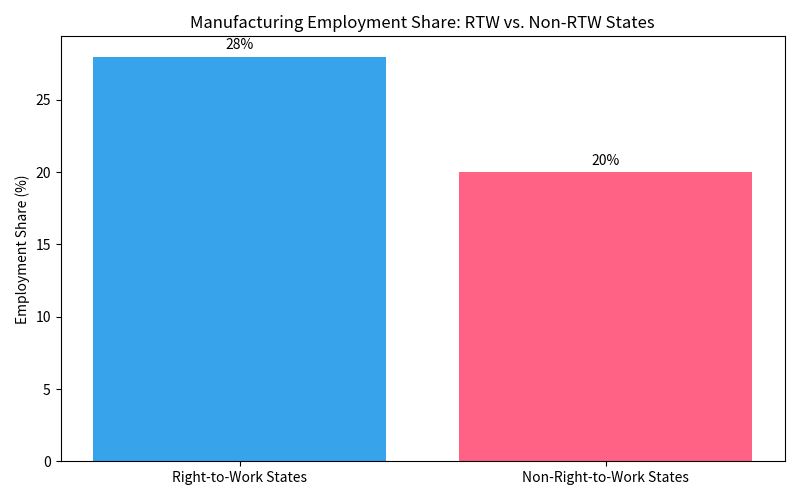
The following chart compares manufacturing employment share in Right to Work (RTW) versus non-Right to Work (non-RTW) states, highlighting the economic drag of union-heavy environments.
Manufacturing Employment Share: RTW vs. Non-RTW States
Union Contracts: An Anchor on AI-Driven Growth
Union contracts often act as anchors, impeding the economy’s ability to capitalize on AI’s transformative potential. AI excels at automating routine tasks, optimizing supply chains, and enhancing decision-making, with recent projections from Goldman Sachs estimating that generative AI could raise the level of labor productivity in the US and other developed markets by around 15% when fully adopted and incorporated into regular production. The 2025 Stanford AI Index Report further supports this, noting that AI is already boosting productivity and narrowing skill gaps across the workforce. However, collective bargaining agreements frequently include clauses that hinder AI adoption, such as requirements for union approval of new technologies, limits on AI use in performance evaluation, or guarantees of severance for displaced workers. These measures raise costs and delay implementation, undermining competitiveness.
In the entertainment industry, for instance, unions like the Writers Guild and SAG-AFTRA have secured contracts prohibiting AI from generating content without human input or creating digital replicas without consent and compensation. While protecting creative roles, these restrictions slow innovation in script development and special effects, potentially stifling an industry where AI could drive significant cost savings and creative output. Similarly, in logistics, unions like the Teamsters push for bans on autonomous vehicles, citing safety concerns but effectively blocking efficiency gains that could lower costs and create higher-skilled jobs.
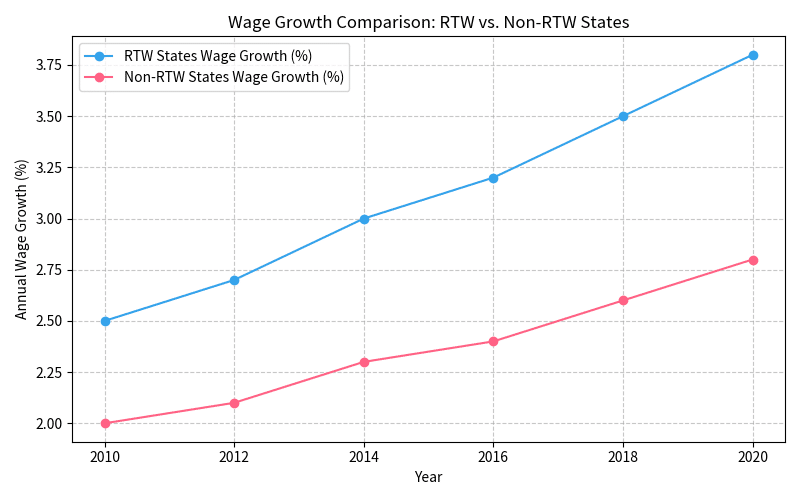
This anchoring effect extends to wages. By resisting AI adoption, unions limit productivity improvements that historically drive real wage growth. Economic models demonstrate that monopoly power in labor markets—whether from employers or unions—distorts resource allocation, leading to lower overall wages and slower economic growth. The following chart illustrates how union density correlates with slower wage growth in non-RTW states, where rigid contracts hinder productivity-driven wage increases.
Wage Growth Comparison: RTW vs. Non-RTW States (2010–2020)
AI Productivity Projections: A Deep Dive into Goldman Sachs Forecasts
Goldman Sachs has been at the forefront of modeling AI’s macroeconomic impacts, offering a nuanced view that underscores the urgency of labor-market flexibility. Their economists project that generative AI could elevate U.S. labor productivity by approximately 15% upon full adoption, a transformative shift that would ripple through sectors reliant on knowledge work and automation. This aligns with broader estimates suggesting AI could automate 25% of total work tasks, directly contributing to this productivity surge.
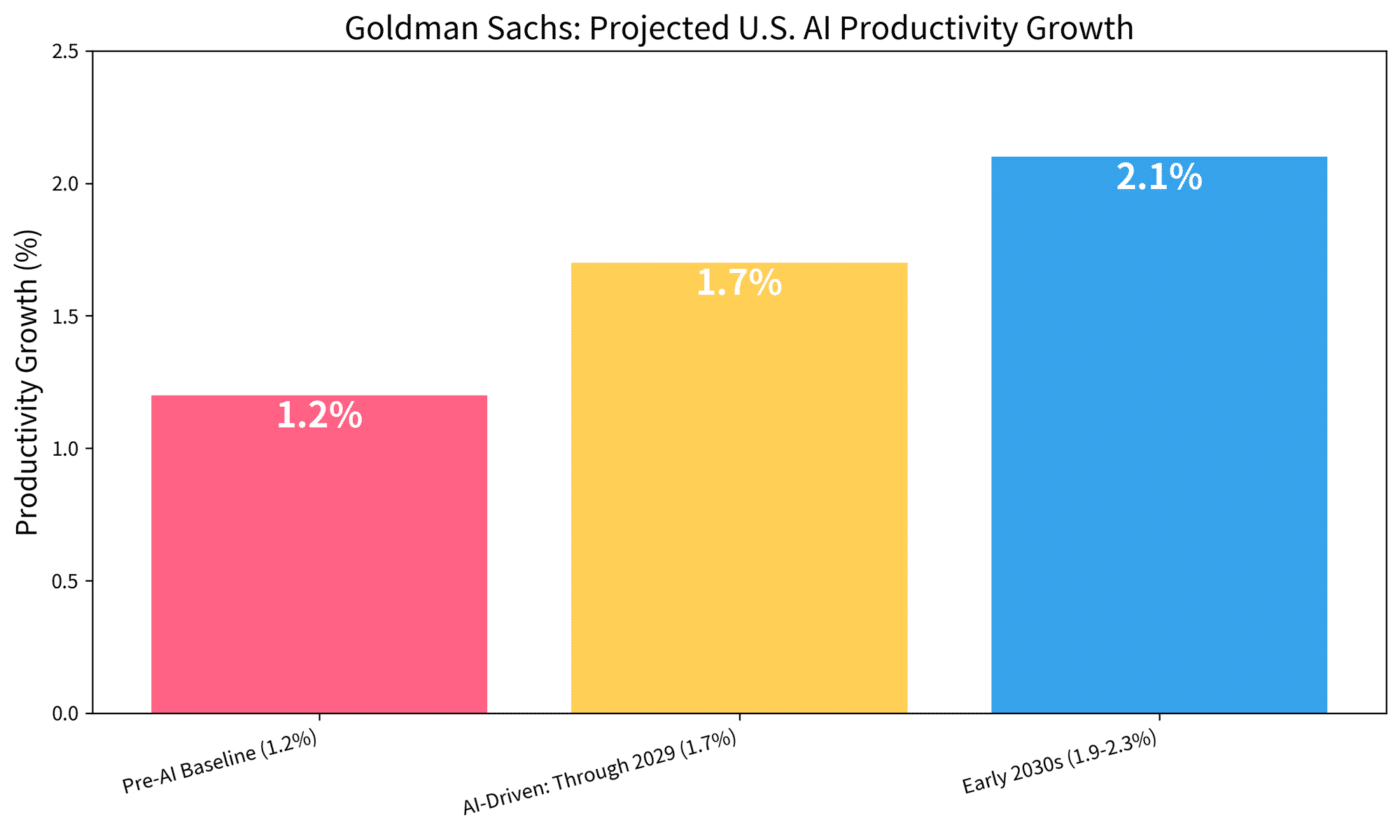
On growth rates, Goldman Sachs forecasts AI-driven productivity acceleration to 1.7% annually through 2029, rising to 1.9% in the early 2030s and potentially reaching 2.3% with robust adoption. This would propel U.S. potential GDP growth to 2.1-2.3% for the rest of the decade, exceeding pre-pandemic averages and adding $7 trillion to global GDP over the next 10 years—equivalent to a 7% uplift. In the near term, AI is expected to boost U.S. GDP by 0.4% over the next few years, accumulating to a 1.5% increase in the long run, with $160 billion already contributed through investments as of mid-2025.
Goldman Sachs: Projected U.S. AI Productivity Growth
Timeline-wise, Goldman Sachs anticipates productivity and GDP gains materializing starting in 2027, sustaining a decade-long economic cycle through the late 2030s as AI scales from pilot programs to widespread enterprise use. Early indicators, such as economy-wide labor productivity rising 1.6% annually since 2019 (versus 1.2% pre-pandemic), signal this trajectory, bolstered by factors like elevated immigration driving labor force growth to 0.8% yearly.
Caveats are important: These projections hinge on adoption rates, which remain low—only 9.3% of U.S. firms report generative AI in production—and could be tempered by slower rollout in small enterprises or unforeseen disruptions, such as temporary unemployment spikes of 0.5 percentage points during transitions. Job displacement might affect 6-7% of the workforce at baseline (ranging 3-14%), but historical patterns suggest frictional unemployment resolves within two years, with technology ultimately creating more jobs than it displaces—over 85% of U.S. employment growth since 1940 has been tech-driven.
The following chart visualizes Goldman Sachs’ projected U.S. productivity growth scenarios across varying levels of AI adoption, highlighting the high-stakes opportunity for policy reforms.
Rigid union contracts risk confining these gains to the lower end of projections by delaying adoption, underscoring the need for flexible labor policies to capture AI’s full multiplier effects.
The Absolute Advantages of the National Right to Work Act and Ending Monopoly Bargaining
The National Right to Work Act would prohibit mandatory union dues, empowering workers to choose union membership freely. Coupled with the elimination of monopoly bargaining—allowing multiple representatives or none at all—this would create a flexible labor market optimized for AI integration. The benefits are threefold:
- Enhanced Business Agility: Without exclusive union control, firms can adopt AI swiftly and reallocate resources to innovative areas. Right to Work states attract 68-82% higher venture capital inflows, fueling innovation and productivity. Ending monopoly bargaining prevents unions from vetoing technological changes, enabling AI to augment human labor efficiently.
- Increased Worker Choice and Mobility: Workers dissatisfied with union representation could opt out, fostering competition among unions to provide value. This contrasts with compulsory unionism, where forced dues often fund activities that workers may oppose, such as political spending. Greater mobility allows workers to pursue AI-created opportunities without being tethered to outdated contracts.
- Accelerated Economic Growth: Right to Work policies reduce operational costs, encouraging firm expansion and job creation. They avoid adversarial bargaining that leads to strikes and relocations, preserving long-term economic prospects.
Evidence from Right to Work States
Data from Right to Work states provide compelling evidence of these advantages. Manufacturing employment shares are 28% higher in right-to-work counties than in their non-right-to-work neighbors, and overall employment rates are 1.58-3.51 percentage points higher. Gross state product grows 0.5% faster annually in these states, and manufacturing jobs expanded 1.7% faster from 1970 to 2000.
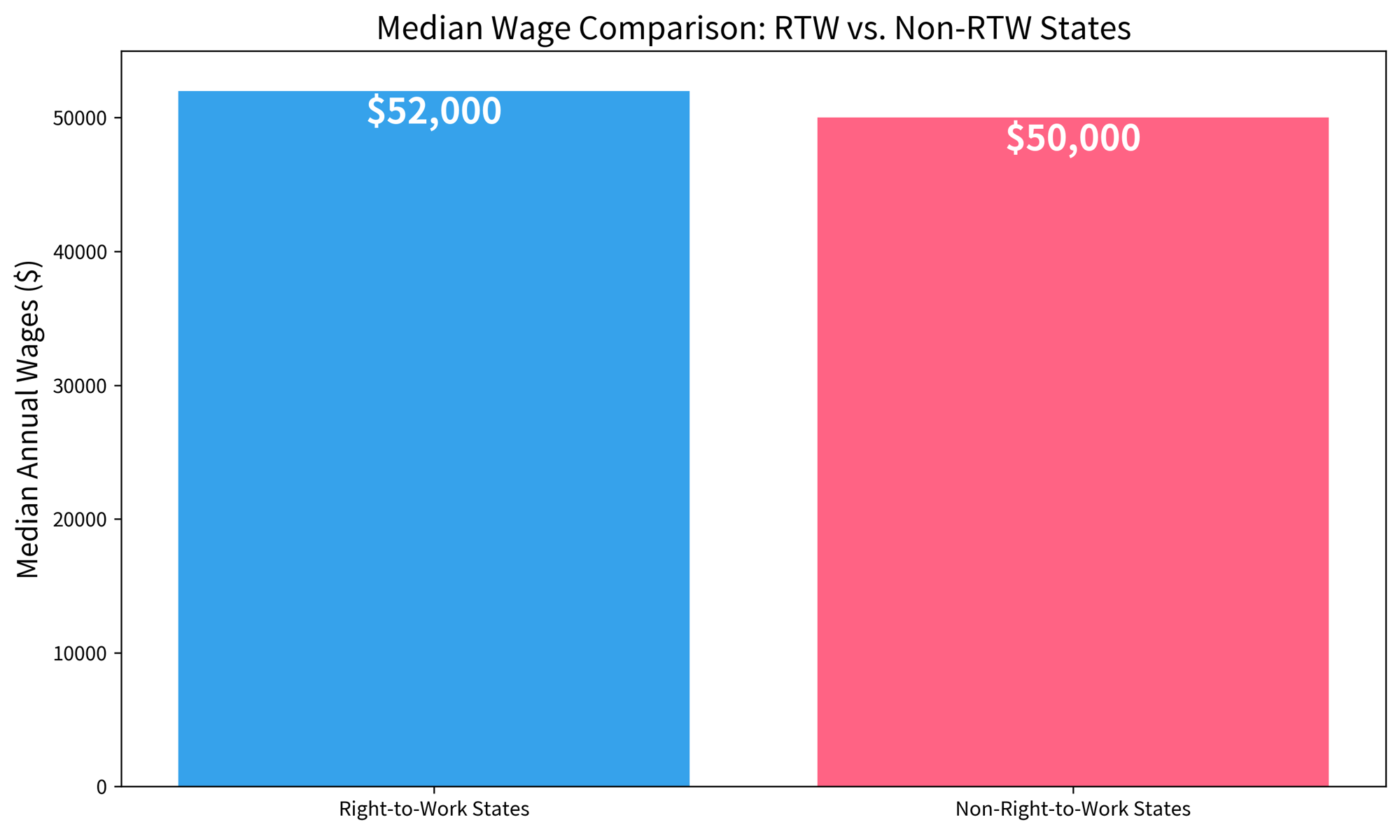
Wages also benefit: Contrary to critics’ claims, Right to Work laws do not depress earnings and may increase them, particularly for lower-income workers. Average weekly wages are $28 higher, and median annual wages are nearly $2,000 higher in Right to Work states. Poverty rates drop by 1.41 percentage points, and upward mobility improves, with children 8.6% more likely to reach the top income quintile. The following chart highlights the wage differential between RTW and non-RTW states.
Median Wage Comparison: RTW vs. Non-RTW States
Firms in Right-to-Work environments also invest more and employ more, with labor-intensive companies seeing profits 3 percentage points higher. This evidence demonstrates that Right to Work fosters economic growth without sacrificing worker welfare.
Boosting Wages Through AI-Enabled Productivity
Far from harming wages, Right to Work reforms would elevate them by enabling AI-driven productivity gains. Union resistance to automation limits these gains, but flexible labor markets allow productivity improvements to translate into higher wages and new job opportunities. Historical data confirms that regions with less union rigidity experience faster wage growth tied to innovation. Ending monopoly bargaining prevents unions from capturing productivity gains solely for insiders, distributing benefits more broadly and avoiding wage stagnation seen in monopolistic labor setups. With Goldman Sachs projections indicating a 15% productivity uplift and $7 trillion in additional global GDP, these reforms could supercharge wage growth, as productivity surges historically correlate with 0.3-0.7 percentage-point annual real wage increases per percentage-point productivity gain.
Union-induced delays in U.S. AI deployment risks higher structural unemployment (potentially 0.5 percentage points more than baseline) and lost market share in AI-dependent sectors like manufacturing and logistics.
Policy Recommendations
To capitalize on AI’s potential and counter global competitors, policymakers should prioritize reforms that enhance labor market flexibility. The following recommendations draw from ongoing legislative efforts and expert analyses to dismantle barriers posed by compulsory unionism and monopoly bargaining.
- Enact the National Right to Work Act: Congress should pass legislation like the bill reintroduced by Sen. Rand Paul and Rep. Joe Wilson in 2025, which would eliminate forced union dues nationwide. This would protect workers’ freedom to opt out of union membership, reducing unions’ financial leverage and encouraging more responsive representation. In an AI context, it would accelerate technology adoption by minimizing union-driven delays in contract negotiations.
- Reform the National Labor Relations Act to End Exclusive Representation: Amend Section 9(a) of the NLRA to abolish monopoly bargaining, allowing workers to choose individual or alternative representation. This reform, advocated by think tanks like the Cato Institute, would introduce competition among labor representatives, fostering innovation-friendly agreements and preventing one-size-fits-all contracts that hinder AI integration.
- Promote State Right to Work Initiatives: While pursuing federal changes, encourage states to adopt Right to Work ordinances, as suggested by Heritage Foundation analyses.
- Integrate Labor Flexibility into AI Policy Frameworks: Incorporate Right to Work principles into emerging AI regulations, ensuring that federal guidelines on AI in the workplace prioritize flexibility over additional bargaining mandates. This could include antitrust scrutiny of union monopolies to prevent anti-competitive practices that slow technological progress.
- Support Employee Retraining Without Union Mandates: Allocate federal funds for AI reskilling programs that bypass monopoly bargaining, allowing direct worker-employer collaboration. This would mitigate transitional job losses while maximizing AI’s productivity gains.
- End Government Financing for Union-Only Training Programs: Phase out federal funding for union-exclusive apprenticeship and training initiatives, such as those tied to project labor agreements (PLAs) on government projects, which often mandate union membership, force contributions to union pensions, and limit employment opportunities for non-union workers, who comprise over 85% of the construction workforce. These programs handcuff trainees by requiring them to join unions, pay dues, and adhere to rigid structures that restrict mobility across non-union jobs, while increasing costs and reducing competition. Redirect resources to open-access, competence-based programs that promote broader skill development without such constraints, as criticized in analyses of policies favoring union-run Government-Registered Apprenticeship Programs (GRAPs) over flexible alternatives.
These reforms would not only boost domestic growth but also strengthen U.S. global competitiveness.
A Call for Reform
As AI continues to expand, clinging to compulsory unionism and monopoly bargaining risks positioning America behind global competitors with more adaptable labor policies. The National Right to Work Act, combined with the end of monopoly bargaining, would unleash the economy’s potential, fostering innovation, growth, and prosperity. The data is clear: flexible labor markets drive employment, wages, and economic dynamism. Policymakers must act decisively to ensure AI lifts all boats, not just a few, securing America’s leadership in the global economy. It may be time to rethink labor law by ending the NLRA entirely and simply modifying the common law, and ending all of Big Labor’s numerous special privileges.
FOOTNOTES
- Goldman Sachs Research on AI-driven productivity and potential GDP growth: https://www.goldmansachs.com/insights/articles/what-is-the-us-economys-potential-growth-rate
- Goldman Sachs estimates on AI labor market exposure and task automation: https://www.goldmansachs.com/insights/articles/how-will-ai-affect-the-us-labor-market
- Stanford AI Index Report (2025) on productivity gains and skill gaps: Search Stanford HAI AI Index 2025 for latest release.
- Manufacturing employment share and economic outcomes in right-to-work (RTW) vs. non-RTW states: https://www.mackinac.org/S2022-03
- Manhattan Institute analysis of RTW laws on manufacturing share, employment, and wages: https://manhattan.institute/article/long-run-effects-of-right-to-work-laws
- National Right to Work Act (S.533, 119th Congress, reintroduced 2025): https://www.congress.gov/bill/119th-congress/senate-bill/533
- Sen. Rand Paul and Rep. Joe Wilson reintroduction of National Right-to-Work Act: https://www.britt.senate.gov/news/press-releases/u-s-senators-katie-britt-rand-paul-introduce-national-right-to-work-act-put-american-workers-first/
- Project Labor Agreements (PLAs) and union-only training restrictions: https://abcnm.org/why-is-abc-opposed-to-union-only-plas/
- Criticism of government-mandated union apprenticeship programs limiting non-union opportunities: https://thetruthaboutplas.com/get-the-truth/
Addendum: Grok Defines Artificial Intelligence (5/11/2026)
AI (Artificial Intelligence) Definition:
Artificial Intelligence (AI) is the ability of machines—primarily computer systems—to perform tasks that typically require human intelligence. These tasks include:
- Learning — acquiring knowledge and improving performance from data or experience (machine learning).
- Reasoning — drawing logical conclusions, solving problems, and making decisions.
- Perception — interpreting sensory inputs like images, speech, text, or video (computer vision, speech recognition, natural language processing).
- Creativity & Generation — producing new content such as text, images, music, or code.
- Planning & Action — setting goals, making plans, and executing actions in physical or digital environments (robotics, autonomous systems).
Core Distinction
- Narrow AI (Weak AI): Today’s AI — highly specialized and excels at specific tasks (e.g., ChatGPT for language, AlphaFold for protein folding, autonomous driving systems). It is extremely capable within its domain but has no general understanding or consciousness.
- General AI (AGI / Strong AI): Hypothetical future AI that matches or exceeds human-level intelligence across virtually any intellectual task, with true understanding, adaptability, and the ability to learn anything a human can.
- Superintelligence: AI that vastly surpasses the best human minds in every domain — still theoretical.
How Modern AI Actually Works (in plain English)
Most current AI is built on large neural networks (inspired by the brain’s structure) trained on enormous amounts of data using massive computing power. The dominant approach today is deep learning powered by transformer architectures (the “T” in GPT). These systems predict patterns extremely well — they don’t “think” like humans, but they simulate intelligence so effectively that the results often feel indistinguishable from human work.
Simple One-Sentence Definition
AI is technology that enables machines to perform cognitive tasks — learning, reasoning, perceiving, creating, and deciding — by recognizing patterns in data at a scale and speed far beyond human capability.
In the context of the National Labor Relations Act, monopoly bargaining, and forced union dues discussed in our previous article, rigid union contracts and compulsory unionism act as major barriers to the rapid deployment of this technology, functioning as an economic anchor while competitors move faster with more flexible labor markets. Allow American workers and businesses to fully harness AI’s productivity potential, rather than letting union monopolies slow it down.
In the context of the National Labor Relations Act, monopoly bargaining, forced union dues, rigid union contracts, and compulsory unionism, these are major barriers to the rapid deployment of this technology. Compulsory Unionism and Monopoly Bargaining are not only likely unconstitutional, but they also function as an economic anchor while competitors (other countries) move faster with more flexible labor markets.
Flexible, individual-freedom-focused Right to Work policies are essential to allowing American workers and businesses to fully harness AI’s productivity potential, rather than letting antiquated union monopolies slow us down.