
Harvard Law Review: U.S. Workers Slowly Clawing Constitutional Freedoms Back from Forced Union Association Schemes
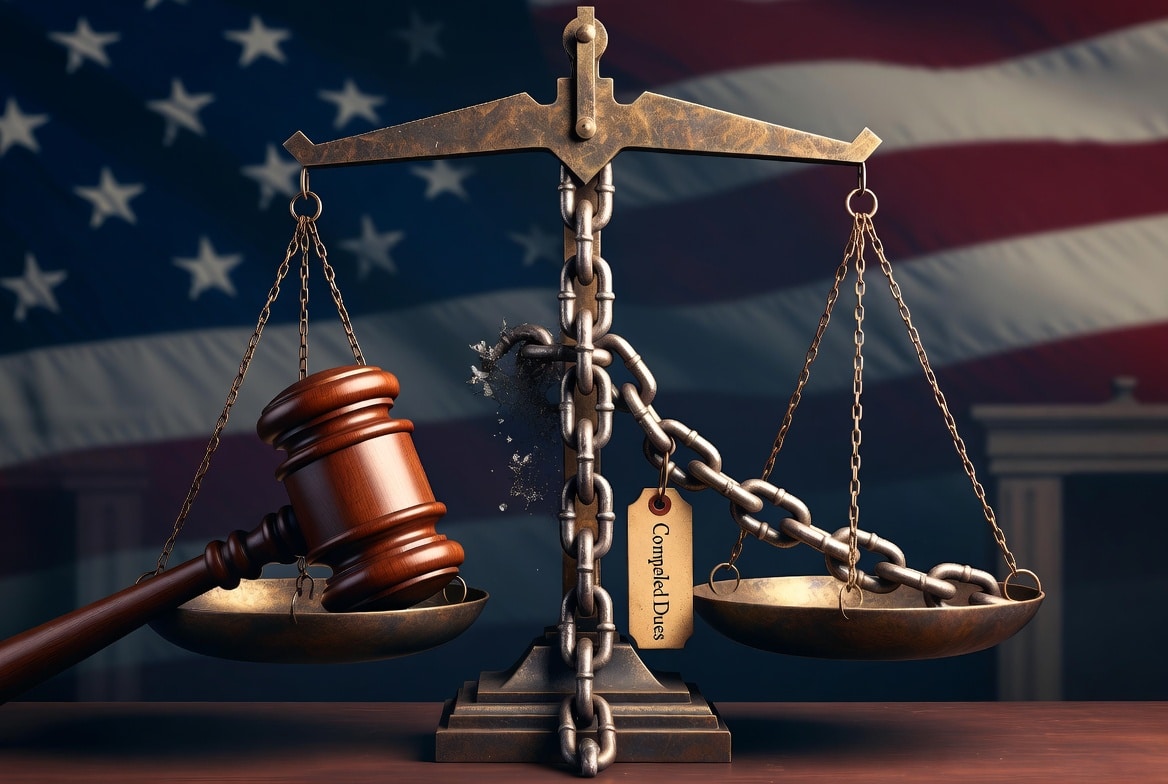
or, The Supreme Court’s Role in Destroying & Now Restoring Worker Freedom: How Key Decisions Limited Compulsory Union Power and Redefined Organized Labor
Yet, SCOTUS Continues Slow-Walking Constitutional Freedom Back to America’s Workers
In an era when public approval of unions remains relatively high yet private-sector union density hovers near historic lows, it is worth examining how Supreme Court jurisprudence has reshaped the role of organized labor. A recent Harvard Law Review Note, “Redefining Organized Labor: How the Supreme Court Circumscribed the Role of Private Sector Unions in American Communities,” thoughtfully traces this evolution. While the Note laments a shift away from union bosses’ power over employees’ rights, the decisions it analyzes represent vital protections for individual workers’ rights against compelled association and speech.
The National Right to Work Legal Defense Foundation (NRTWLDF) has played a central role in many of these landmark cases, defending employees who objected to having their wages funneled into union activities they did not support. These victories have helped ensure that unions function primarily as collective bargaining representatives rather than de facto political or social organizations funded by compulsory dues.
From Broad “Associational” Unions to Narrow Bargaining Agents
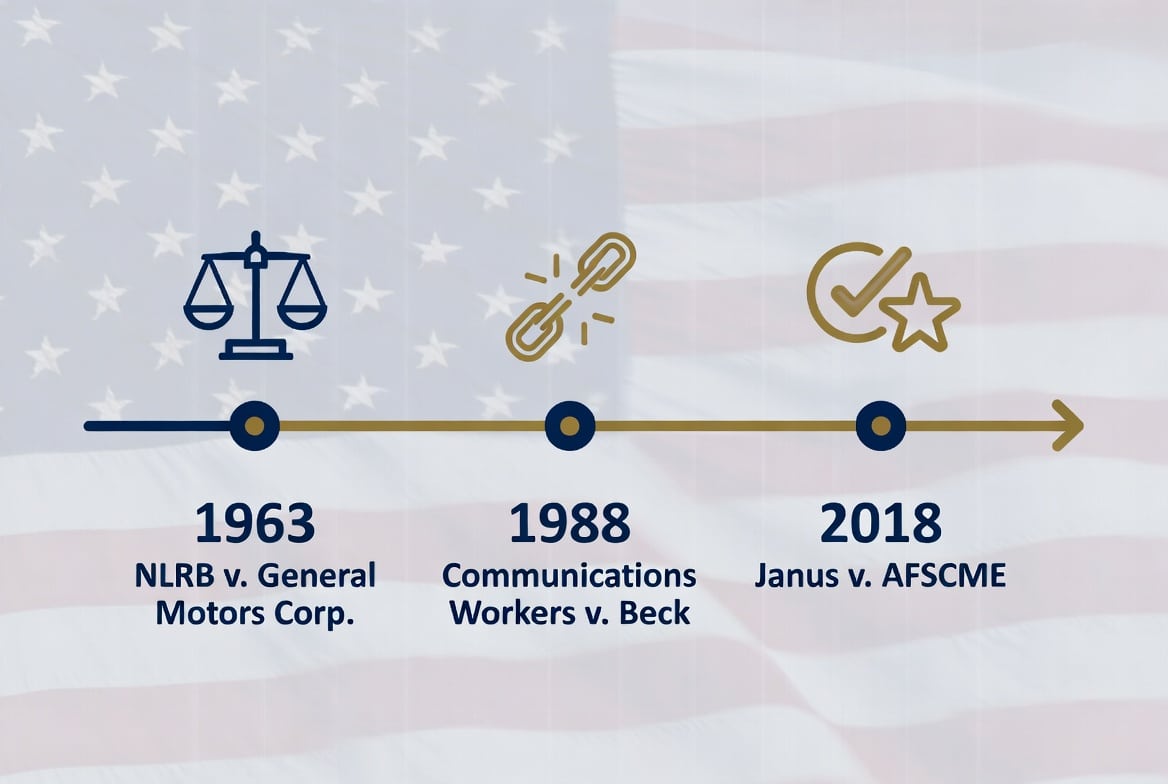
Mid-20th-century unions often operated as multifaceted community entities—sponsoring recreational leagues, newsletters, charitable events, and more—supported in part by full dues from all workers covered by union security agreements. In NLRB v. General Motors Corp. (1963), the Supreme Court upheld agency shops in non-right-to-work states, allowing unions to require “financial core” payments as a condition of employment while distinguishing this from full participatory membership.
Objectors had to pay but could refrain from active involvement. The Court’s approach reflected an “associational” view of unions but continued to permit significant compelled financial support for a wide range of union expenditures.
By the 1980s, the Court began tightening these rules, recognizing that forcing workers to subsidize union officials’ actions raised serious statutory (and, in the public sector, SCOTUS clearly saw constitutional) concerns.
The Pivotal Role of NRTWLDF in Communications Workers v. Beck (1988)
One of the most consequential cases was Communications Workers of America v. Beck (1988), brought with NRTWLDF representation. Harry Beck and other AT&T workers challenged the use of their agency fees for political, lobbying, and non-bargaining activities. The Supreme Court held that under Section 8(a)(3) of the NLRA, unions may collect from non-members only those fees “necessary to performing the duties of an exclusive representative”—i.e., collective bargaining, contract administration, and grievance adjustment.
This decision built on earlier Railway Labor Act (RLA) precedents, such as Ellis v. Brotherhood of Railway Clerks, and directly incorporated arguments advanced by the NRTWLDF in both cases. The Supreme Court rejected the notion that unions could treat objectors’ money as a general fund for any “institutional” purpose. Unions must now comply with complicated reporting schemes that provide difficult-to-enforce notices and mechanisms for objections, though enforcement remains an ongoing challenge that NRTWLDF continues to litigate.
Broader Impact and Complementary Cases
Beck aligned with a series of NRTWLDF-supported victories that reinforced employee freedom:
- Political and ideological spending limits: Building on Street (1961) and Abood (1977, later overruled for the public sector in Janus), the Court repeatedly added gradual restrictions on a labor union’s ability to use non-member funds for politics.
- Resignation and membership rights: Cases affirming workers’ unqualified right to resign from union membership immediately (though immediately is not always as quick as one might think), preventing perpetual financial entanglement.
- Affirmative consent requirements: Later public-sector extensions (e.g., Janus v. AFSCME, 2018, argued by NRTWLDF’s William Messenger) emphasized that compelled subsidies violate First Amendment rights, providing a model for private-sector accountability.
Though compulsory fees and monopoly bargaining continue to trample on employees’ constitutional rights, these rulings collectively somewhat attempted to “circumscribe” unions to their statutory core under the NLRA—bargaining on behalf of employees in the unit—rather than operating as expansive socio-political entities. A simple review of May Day Labor Union Activities and Chaos undermines any court’s belief in the latter. Labor union-supported scholars may view this as diminishing unions’ community role, but open-minded scholars see it as partially preventing abuse of government-granted monopoly bargaining power to extract funds for purposes unrelated to workplace representation.
In Right to Work states (26 states), workers already enjoy broader protections against compulsory dues. Federal decisions like Beck extend similar principles nationwide for non-members, complementing state laws by limiting what even mandatory fees can support. But, Right to Work Laws do not protect employees from unconstitutional monopoly bargaining, which takes away from every employee lassoed into a union contract their right of personal agency.
Sociological and Practical Consequences
By requiring unions to justify expenditures and refund or rebate non-chargeable portions, these decisions have encouraged some transparency and responsiveness. Unions must now compete for voluntary membership and support rather than always relying on compulsory mechanisms. This shift arguably strengthens genuine worker representation while allow some protection for dissenters—though far from core American values of free association.
Data from the National Institute for Labor Relations Research and other sources consistently show that compulsory unionism correlates with economic drawbacks in some metrics, while Right to Work states often attract more investment and jobs. The Court’s jurisprudence has slowly helped level the playing field, but has failed to ensure that no worker is forced to subsidize causes—political, charitable, or organizational—that conflict with their beliefs or desires.
Conclusion: A Continuing Legacy of Worker Protections
The Supreme Court’s evolution from deferring to broad union spending in the associational era to enforcing narrow limits in Beck and beyond marks a redefinition that has prioritized individual liberty. NRTWLDF’s tireless litigation has been instrumental in this progress, turning abstract rights into enforceable protections for millions and exposing the unconstitutional conditions of America’s current labor laws.
As labor policy debates continue amid changing administrations and legal challenges, these precedents create barriers to employees’ freedom while granting some freedoms. True empowerment comes not from compelled solidarity but from voluntary cooperation and the freedom to refrain.
On America’s 250th anniversary, we should celebrate by granting full freedom to all working Americans, instead of perpetuating the outdated practice of compelling some to subsidize labor unions against their will.