
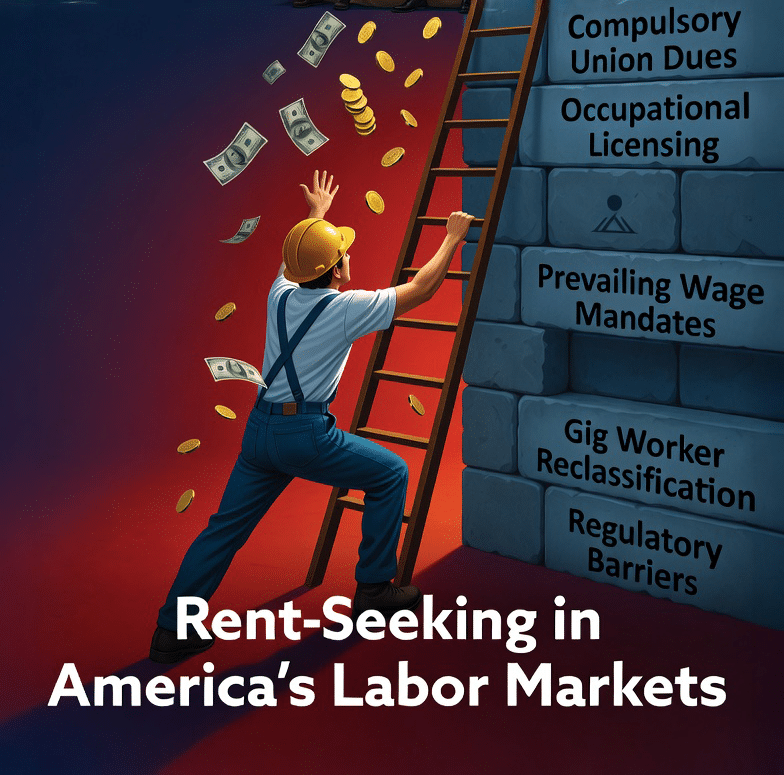
Rent-Seeking in America’s Labor Markets
How Big Labor Special Interests Use Government Power to Capture Wealth
Rent-seeking is one of the most destructive yet least understood forces in modern economies. It occurs when individuals, firms, or organized groups spend resources—time, money, lobbying—to capture a larger share of existing wealth without producing new goods, services, or value for society.
Instead of innovating, competing, or serving customers better, rent-seekers turn to government: regulations, laws, subsidies, and mandates that artificially raise their incomes or protect their privileges. The result? Resources are wasted on politics rather than production. Consumers pay higher prices. Would-be workers lose job opportunities. Economic growth slows. Everyone outside the favored group bears the diffuse costs.
Nowhere is rent-seeking more pervasive—or more costly—than in America’s labor markets. From compulsory unionism to occupational licensing, prevailing-wage laws, gig-worker reclassification rules, and strategic minimum-wage campaigns, concentrated interest groups (often unions and incumbent professionals) routinely use state power to extract “rents” from workers, employers, taxpayers, and consumers. These are not abstract economic theories. Rent-seeking is an everyday mechanism that distorts wages, limits opportunities, and transfers trillions of dollars every year, creating harmful economic inefficiencies penalizing employees, employers, taxpayers, and consumers.
Compulsory Unionism: The Textbook Case of Labor-Market Rent-Seeking
Compulsory unionism—where government grants a labor union exclusive bargaining rights over all workers in a contractually agreed employee unit and that allows forced dues or “agency fees” as a condition of employment—is perhaps the clearest example.
Under the National Labor Relations Act (NLRA), once a union wins a certification election (sometimes by a slim margin), it speaks for everyone, including those who voted no or want no part of it. Employees can be fired for refusing to pay the union, even if they disagree with its political spending or contract priorities.
This government-enforced monopoly creates artificial economic rents: higher wages and benefits for insiders, funded not by greater productivity but by transfers from non-union workers (who face fewer job openings), consumers (who face higher prices), and employers (who face reduced flexibility).
The resources poured into organizing drives, lobbying against Right to Work laws, and fighting for “card-check” or other pro-compulsion rules are classic rent-seeking expenditures. Economists across the political spectrum—from Milton Friedman to public-choice scholars—have long recognized that much of the union wage premium is a transfer, not a productivity gain. Union officials gain power and compensation; existing members enjoy protected privileges; outsiders and the broader economy bear the cost in slower job growth, reduced investment, and misallocated labor.
Right to Work laws, which simply ban compulsory dues, are a direct policy response to this Big Labor rent-seeking. Right to Work Law forces unions to compete for union members by delivering real value rather than relying simply on government coercion, such as “pay demanded dues or be fired,” with the National Labor Relations Act’s blessing.
Occupational Licensing: Barriers to Entry That Protect Insiders
Another massive labor-market rent-seeking engine is occupational licensing. Roughly 22–25% of American workers now need a government license to do their jobs—an explosion from fewer than 5% in the 1950s. Barbers, cosmetologists, interior designers, florists, manicurists, and even some construction trades have successfully lobbied states to impose costly training hours, exams, and fees.
The stated goal is always “public safety” or “quality.” The actual effect, documented in dozens of economic studies, is higher wages for those already licensed (an 8–15% premium in many fields) and fewer opportunities for everyone else. Many of these rules have little measurable impact on service quality once basic health and safety standards are met. The real purpose is to restrict supply, raise prices, give union trading programs extra control of markets, and protect existing earners by replacement barriers rather than job performance.
Would-be workers spend thousands of dollars and hundreds of hours jumping through hoops instead of entering the workforce. Consumers pay more for haircuts, flowers, home renovations, and government services than fair-market prices. The clear winners are the licensed insiders and the state licensing boards that collect fees. This is rent-seeking in its purest form: using political power to erect artificial barriers that transfer income.
Prevailing-Wage Laws (Davis-Bacon and “Little Davis-Bacon”): Taxpayer-Funded Protectionism
Federal and state “prevailing-wage” laws, most famously the 1931 Davis-Bacon Act, require government contractors on public construction projects to pay union-scale wages and benefits—even when a non-union firm could do the same work cheaper and win the bid on merit.
Unions and unionized contractors lobby aggressively to maintain and expand these mandates. The result is predictable: non-union workers and firms are effectively walled off from taxpayer-funded work. Projects cost 7–20% (or more) extra, according to multiple analyses. That is a 7-20% tax increase with no added benefit to taxpayers. That money doesn’t buy better quality or safety; it simply transfers wealth from taxpayers and open-shop workers to union insiders.
Project Labor Agreements (PLAs) take it further, often forcing every worker on a big public project into union rules and dues, regardless of their preferences. Again, the mechanism is textbook rent-seeking: concentrated interests (unions) use government contracts to block competition and capture rents at the expense of dispersed taxpayers and non-union labor.
Restrictive Worker-Classification Rules and the Attack on the Gig Economy
Laws like California’s AB5 (and similar proposals elsewhere) reclassify independent contractors and gig workers as “employees.” Pushed heavily by traditional unions and labor political groups, these rules aim to make it easier to unionize platforms like Uber, Lyft, and delivery services—and to impose additional regulations and the associated costs onto the drivers and companies.
The rent-seeking motive here is transparent: protect the traditional unionized labor model cab companies from lower-cost, flexible competition. Independent workers who value control over their hours and schedules lose options. Platforms like Uber and Lyft face higher costs, which get passed on to consumers or result in fewer service requests.
Studies after AB5 showed that many drivers earned less per hour after reclassification, and some platforms reduced operations. Once more, government power is used to raise rivals’ costs, preserve rents for incumbent labor organizations, reduce income-earning options for drivers, while reducing consumers’ options, and increasing their expenses.
Minimum-Wage Laws as a Strategic Tool
While minimum wages may seem to have legitimate policy rationales around the vague “fairness” argument, unions sometimes champion large increases even in sectors where few people earn just the statutory minimum. Why? A higher wage floor can price low-cost non-union competitors out of the market, making union labor seem competitive while protecting unionized companies from entrants who may pay by the project rather than by the hour.
This dynamic turns a well-intentioned policy into a partial rent-seeking vehicle: using government to raise competitors’ labor costs without any corresponding productivity gain. The concentrated benefits are intended to flow to unionized workers, their union bosses, and the employer; the costs (lost jobs, reduced hours, higher prices) are spread across low-wage workers, consumers, and taxpayers, subsidizing the enforcement of these schemes.
The Broader Costs—and Why It Matters
All these examples share the same public-choice logic of labor union officials. Empowered by forced union dues, a captive worker group, numerous tax exemptions, and other laws, they are incentivized to lobby for even more special privileges. Why not? The costs of the grifts are borne by others in large, unorganized groups (consumers, non-union workers, the self-employed, taxpayers). The result? Slower, less efficient, and less effective economic growth, reduced mobility, higher prices, individual rights ignored, and fewer job opportunities—especially for young, low-skilled, or minority workers who are disproportionately harmed by entry barriers.
Economists have shown that the social costs of rent-seeking often far exceed all the private gains. Resources spent on lobbying, compliance, and political battles are resources not spent on innovation, training, or capital investment.
The good news is that these policies are not inevitable. Right to Work laws, licensing reform, repeal or reform of Davis-Bacon rules, and resistance to forced reclassification of independent contractors are proven ways to reduce rent-seeking and restore genuine competition in labor markets.
America’s labor markets should reward productivity, innovation, and voluntary cooperation—not political favoritism. When government becomes a tool for extracting rents rather than protecting all Americans through open competition, the biggest losers are typically the harmed working men and women, consumers, and taxpayers who are never allowed at the bargaining table.
Fear and inaction have led to the trampling of individual hardworking Americans’ rights and freedom by the Wagner Act and its surviving remnants. Like Patrick Henry, it is time for America to wake up to the fact that the New Deal was a bad deal that trampled individual rights while compelling workplace conflict by interjecting an actor dependent on conflict and tension to survive. The National Labor Relations Board has become a star chamber that punishes Americans for disagreeing with the entrenched power of union bosses. It is time to repeal the Wagner Act and the laws that have been built upon it, to eliminate the National Labor Relations Board, and to restore to individual Americans the right to freely contract for their labor, to associate or not associate as they see fit, and to be free from the coercion of government-sponsored unionism. Just as our Founding Fathers threw off the yoke of tyranny, so too must we cast off the chains of the Wagner Act and reclaim our economic liberty.
Have you seen rent-seeking in your industry or workplace? Send us a note about your experience. The more we expose these barriers, the more we can push for real labor-market freedom.