
Inside the Teachers’ Union Political Machine: Misclassification, Dark-Money Networks, and Politicized Classrooms (NCRI Report)
Executive Summary
The National Education Association (NEA) and American Federation of Teachers (AFT) control the union contracts of more than 4.7 million people — the vast majority of them public-school educators. Originally chartered to elevate the teaching profession and advance high-quality public education, both unions now function primarily as large-scale political financing operations with limited transparency and weak accountability to the educators who pay their dues.
Bottom Line Up Front (direct from the report): The NEA and AFT have abandoned the educators who fund them.
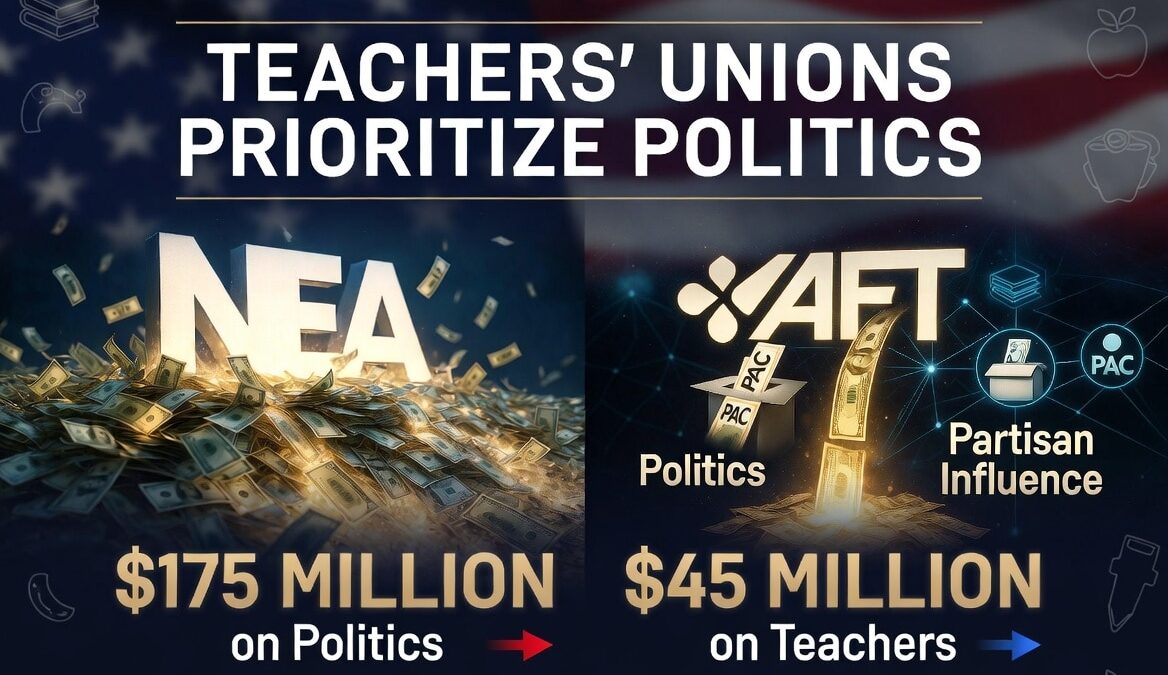
In FY2025 alone, the unions directed approximately $175 million to political activities, lobbying, and outside contributions — nearly four times the $45 million spent on direct member representation, monopoly-bargaining, and grievances. More than 90% of their PAC spending supports Democrat candidates and causes.
A new 36-page report from the Network Contagion Research Institute (NCRI), released May 18, 2026, uses federal IRS Form 990s, DOL LM-2 filings, PAC disclosures, and open-source intelligence to document systemic misclassification of spending, union officials’ self-dealing, and growing influence over classroom content — often at the expense of teacher pay, membership services, and educational neutrality.
Key Findings: Institutional Governance & Spending Priorities
The NEA (2.85 million members, $450 million budget) and AFT (1.8 million members, $275–278 million budget) both direct far more resources into politics than into core union duties. For example:
- NEA political/lobbying + contributions/grants vastly exceed representational activities.
- AFT shows a similar pattern, though it spends slightly more on reportedly representation expenses.
- Even the massive United Federation of Teachers (UFT — NYC AFT affiliate) funnels millions annually into politics while purportedly representing 200,000 members.
Financial Transparency Failures & Misclassification
Federal disclosures reveal repeated examples of contradictory reporting that conceal the true scale of political activity:
- A $500,000 payment to the “No on 2109” ballot committee was reported as political activity on the DOL LM-2 but as charitable “financial assistance” on the IRS Form 990.
- Another $1 million to the Greater Wisconsin Committee was labeled a “ballot initiative grant” but was used for electoral ads and candidate support immediately before an election.
- In FY2024, NEA compensation classified as political work dropped 99% (from a decade average of $7.9 million) with no corresponding drop in overall political spending — then rebounded sharply the next year.
Most political spending (80–90%) is externalized to outside groups (possibly strongly influenced or even controlled by the union) rather than handled by internal staff.
Circuits of Funding & Leadership Self-Dealing
Union dues flow into dark-money networks where top executives simultaneously hold leadership roles:
- Democracy Alliance / Strategic Victory Fund: NEA and AFT have transferred tens of millions. The NEA alone gave $4.9 million to the State Engagement Fund in FY2025 and more than $58 million since 2018.
- The Strategic Victory Fund received $19.3 million from the NEA between FY2020–2022. Former NEA Executive Directors John Stocks and Kim Anderson held top roles at these entities while directing union funds to them — and both now sit on the Strategic Victory Fund’s executive committee.
- Arabella Advisors network: $4.125 million from NEA + $1.1 million from AFT to entities like the Sixteen Thirty Fund.
These overlaps raise serious fiduciary and conflict-of-interest concerns under federal labor law.
Impact on Educators
While unions pour resources into politics:
- Teacher real wages have remained essentially flat for more than 50 years. The teacher pay penalty reached a record 26.9% in 2024 relative to comparably educated professionals.
- NEA membership has declined by roughly 400,000 since 2009 — yet dues continue to rise.
- In 2024, the NEA itself canceled its convention, revoked staff benefits, and used lockout tactics it routinely condemns when applied to teachers.
Policy Influence & Classroom Politicization
The unions’ priorities increasingly shape what happens inside schools:
- COVID reopening resistance: The AFT accessed draft CDC guidance and successfully pushed for stricter language. Strong-union districts reopened later than others, contributing to historic learning losses on NAEP scores.
- Defunding school security: Funding to the Advancement Project helped remove school resource officers and redirect more than $50 million from security budgets in multiple districts.
- Zinn Education Project: NEA ($48K+) and AFT affiliates fund materials that reach 176,000 educators. Lessons frame the United States and Israel as “terrorists” or “evil” and promote “Teach Palestine” content. NEA President Becky Pringle spoke at a 2025 Zinn-linked event.
Conclusion & Call for Reform
The NCRI report concludes that the NEA and AFT operate with “limited transparency and attenuated accountability.” Political spending dominates, misclassification hides the scale, leadership self-dealing diverts dues, and ideological funding politicizes K-12 classrooms. The evidentiary record “warrants scrutiny across oversight channels.”
Read the full 36-page report here: Mission Aborted – NCRI (PDF)
Educators, parents, taxpayers, and lawmakers should demand greater oversight, accurate financial reporting, and a return to the unions’ original missions of supporting teachers and students — not partisan politics.