
Union Official’s Special Privileges: Super-Constitutional Powers That Eliminate Your Rights
Union officials enjoy legal immunities and powers that no other private organization or individual has been allowed by the U.S. Constitution, Congress, or any court. From forced dues to exemptions from violence, these special privileges and exemptions violate workers’ and others' constitutional rights and ignore standard contract law.
Explore the laws, real stories, and help develop the path to reform to give employees and employers their rights back.
How Big Labor Gained Its Power
This is a brief summary of a critical historical analysis from the National Institute for Labor Relations Research. It traces how “Big Labor” (union bosses) transformed from voluntary, business-oriented organizations into a coercive political force through legislative exemptions, government-backed compulsory unionism, and judicial battles.
It contrasts AFL-CIO President Samuel Gompers’ early emphasis on voluntarism (“No lasting gain has ever come from compulsion”) with more recent union Presidents, such as Former SEIU President Andy Stern, who embraced “the persuasion of power,” which is excessively outsized by special privileges and exceptions, and extra-constitutional powers to trample employees' and employers' constitutional rights.
Big Labor’s Top Ten Special Privileges
(Adapted, in part, from the National Right to Work Committee's Research)
U.S. v. Enmons (1973): The U.S. Supreme Court ruled that the Hobbs Act does not cover violence, threats, or property destruction (e.g., gunfire at transformers) if tied to “legitimate” union goals like higher wages. This loophole has shielded thousands of incidents and several related deaths.
Consequences: Victims have lost their lives, been maimed, and other injuries while union officials and their cronies have been allowed to go free or serve only minimal sentences and/or fines while victims were brutalized and had their rights trampled.
Real-World Examples of Union Violence Shielded by Special Privileges
U.S. v. Enmons' decision created bad law and horrific consequences for people opposed to union officials or the goons that they controlled.
Real-World Examples of Union Violence Shielded by Special Privileges
Eddie York
UAW's Kohler Strike
DuPont Hotel Fire
Union militants set ablaze the DuPont Hotel in Puerto Rico during New Year's Eve festivities. Hundreds paid the price, many with their lives.
Button on each: “Read Full NILRR Reporting”
RMI Titanium
Union militants vandalized environmental monitoring equipment and poured oil into electrical conduits during a dispute—classic Emmons-protected tactics.
Button on each: “Read Full NILRR Reporting”
Janus v. AFSCME – Victory for Workers and Additional Implications
Janus v. AFSCME (2018): A Landmark First Amendment Victory
The Janus v. AFSCME U.S. Supreme Court victory was probably the most significant victory for Employee Freedom and rights in the past decade. In Janus v. AFSCME, the U.S. Supreme Court held that public-sector unions cannot force non-members to pay any fees—agency or otherwise—without their affirmative consent, because forcing workers to subsidize union speech violates the First Amendment.
Implications:
• Protects over 5 million government workers, and growing (teachers, first responders, etc.).
• Triggered massive opt-outs and follow-up lawsuits by the National Right to Work Legal Defense Foundation to enforce it. People are still just learning about their rights to stop paying unwanted dues. Visit: MyJanuRights.org now to stop paying your unwanted government union dues or fees.
• Unions have lost significant revenue and membership, yet some continue resistance tactics and have received taxpayer union time to subsidize their unwanted unions.
• And proof that compelled unionism and forced fees are unconstitutional, and may help pave the way for a National Right to Work Act to extend these freedoms to the private sector.
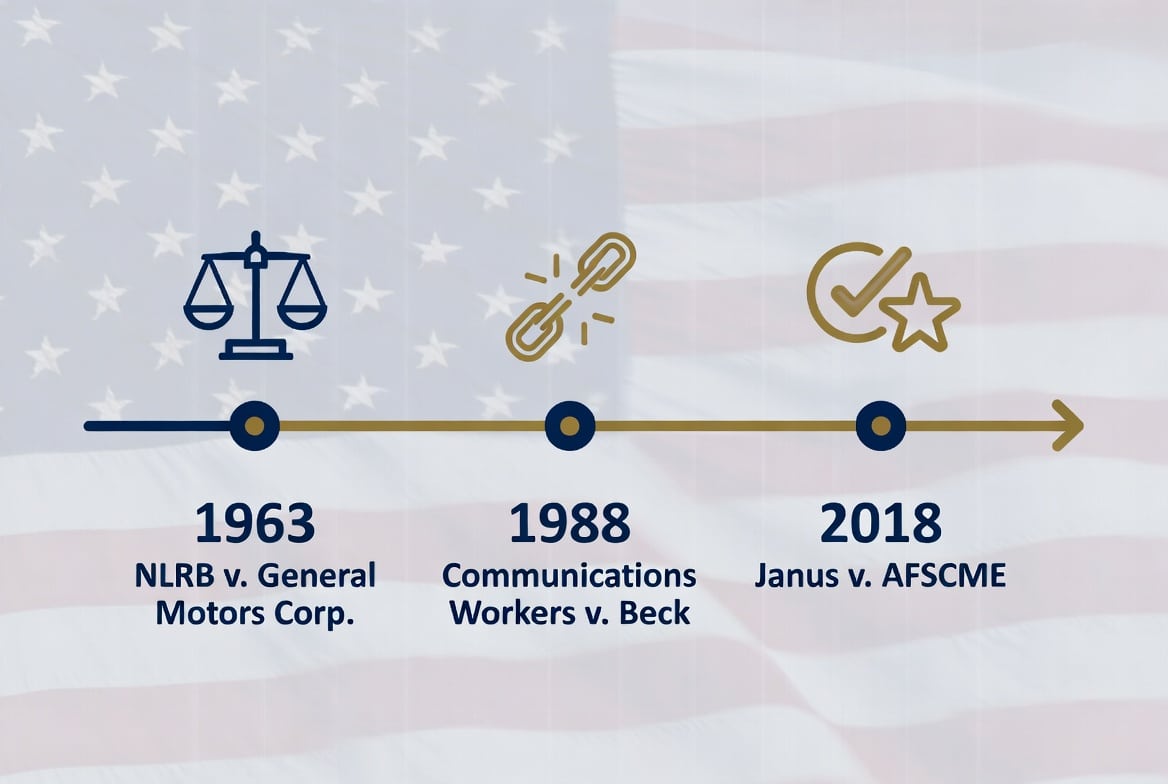
NLRB v. GM applies to private‑sector labor law under the NLRA. It permits agency shops. Janus applies to public‑sector labor law under the First Amendment. It prohibits agency fees without consent. Together, they show a sharp divide: agency fees are "lawful" in the private sector (unless state law forbids them), but unconstitutional in the public sector.

Taft-Hartley Section 14(b) – The Path to State-Level Freedom
Taft-Hartley Section 14(b): Allows States the Right to Ban Forced Unionism.
Enacted in 1947 as part of the Labor Management Relations Act, Section 14(b) amended the NLRA to let every state (and territory) enact Right to Work laws. These laws prohibit unions from requiring membership or dues/fees as a condition of employment—overriding the NLRA’s original allowance of union shops.
Today (2026): 26 states have Right to Work protections, giving workers the freedom to choose. Studies consistently show that Right to Work states enjoy higher job growth, higher wages adjusted for the cost of living, and greater economic opportunity. Expanding 14(b) nationwide would end forced dues everywhere.