
Mock SCOTUS Brief: End NLRA, Restore Individual Employee Rights*
MOCK BRIEF FOR PETITIONERS*
IN THE SUPREME COURT OF THE UNITED STATES
[MOCK BRIEF]
PETITIONERS’ BRIEF ON THE MERITS
SUMMARY OF ARGUMENT
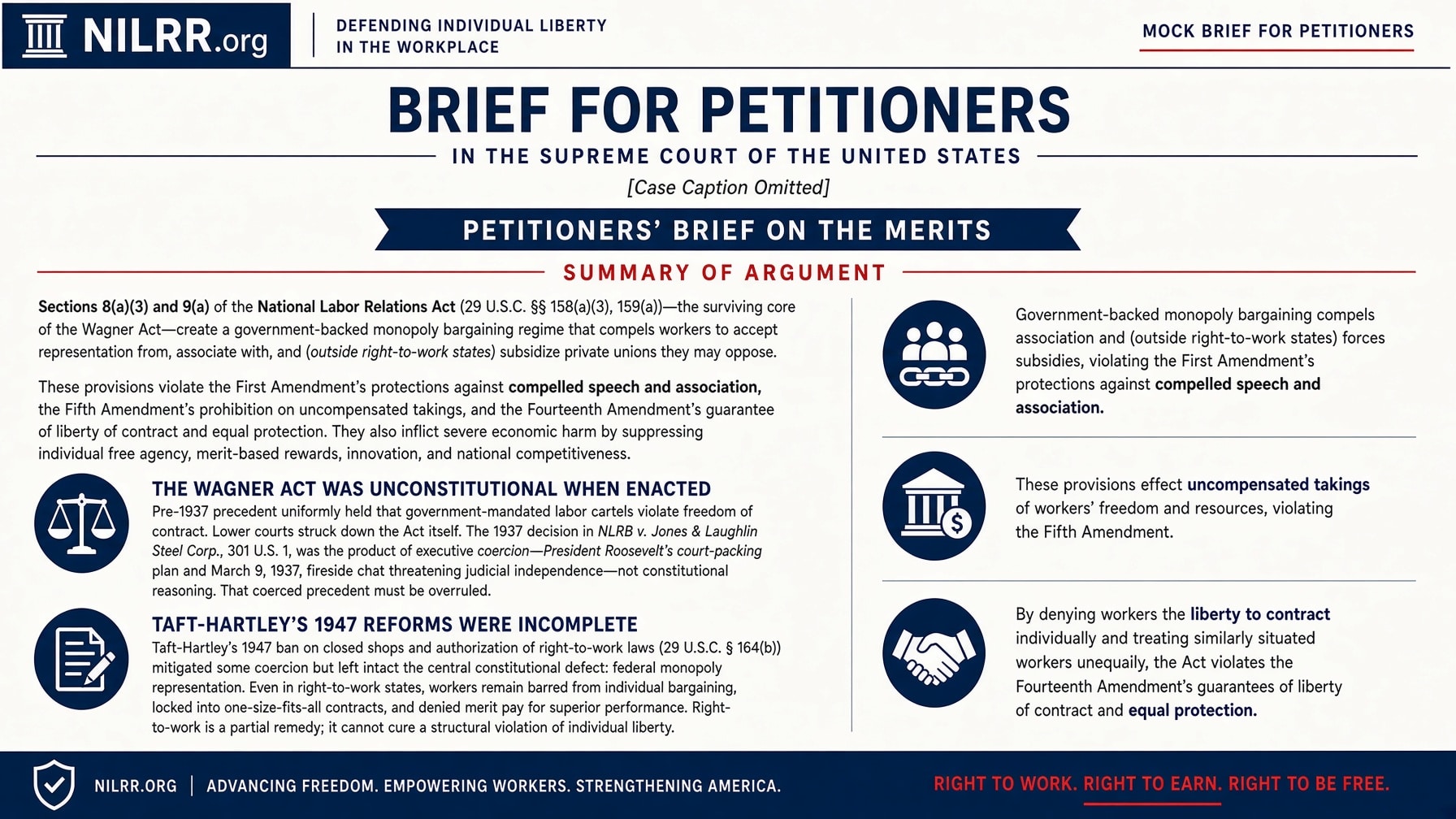
Sections 8(a)(3) and 9(a) of the National Labor Relations Act (29 U.S.C. §§ 158(a)(3), 159(a))—the surviving core of the Wagner Act—create a government-backed monopoly bargaining regime that compels workers to accept representation from, associate with, and (outside Right to Work states) subsidize private unions they may oppose. These provisions violate the First Amendment’s protections against compelled speech and association, the Fifth Amendment’s prohibition on uncompensated takings, and the Fourteenth Amendment’s guarantee of liberty of contract and equal protection. They also inflict severe economic harm by suppressing individual free agency, merit-based rewards, innovation, and national competitiveness.
The Wagner Act was unconstitutional when enacted. Pre-1937 precedent uniformly held that government-mandated labor cartels violate freedom of contract. Lower courts struck down the Act itself. The 1937 decision in NLRB v. Jones & Laughlin Steel Corp., 301 U.S. 1, was the product of executive coercion—President Roosevelt’s court-packing plan and March 9, 1937, fireside chat threatening judicial independence—not constitutional reasoning. That coerced precedent must be overruled.
Taft-Hartley’s 1947 ban on closed shops and authorization of Right to Work laws (29 U.S.C. § 164(b)) mitigated some coercion but left intact the central constitutional defect: federal monopoly representation. Even in Right to Work states, workers remain barred from individual bargaining, locked into one-size-fits-all contracts, and denied merit pay for superior performance. Right to Work is a partial remedy; it cannot cure a structural violation of individual liberty.
Empirical evidence confirms the harm: Right to Work states outperform forced-union states in private-sector job growth (16.4% vs. 7.4%, 2014–2024), manufacturing share, real income, business attraction, and migration. Border-county studies show abrupt economic gains on the Right to Work side. Forced-union states also experience greater wage stagnation, with union decline explaining 20-33% of the rise in wage inequality since the 1970s.
History deepens the injustice: monopoly bargaining empowered many unions to exclude Black workers, enforce racial hierarchies, and incite violence. Government-granted exclusivity weaponized discrimination.
The remnants of the Wagner Act suppress free agency, punish excellence, stifle innovation, and perpetuate economic and racial harm. This Court should overrule Jones & Laughlin, declare Sections 8(a)(3) and 9(a) unconstitutional in their entirety, and eliminate every remnant of the Act’s coercive monopoly scheme.
ARGUMENT
I. MONOPOLY BARGAINING VIOLATES THE FIRST AMENDMENT
Section 9(a) forces every employee into exclusive representation by a majority-selected union, regardless of individual preference. Section 8(a)(3) permits unions to demand discharge for non-payment of dues (outside Right to Work states). Workers are thus compelled to associate with, accept representation from, and subsidize a private organization they may reject.
This is compelled association and compelled speech. Janus v. Am. Fed’n of State, Cnty. & Mun. Emps., Council 31, 585 U.S. 878, 892–93 (2018) held that requiring public employees to subsidize union advocacy violates the First Amendment. Collective bargaining “inherently involves advocacy on matters of public concern,” and forcing dissenters to fund it is unconstitutional. Id. at 892. The same logic governs the private sector. Harris v. Quinn, 573 U.S. 616, 635–36 (2014), already refused to extend forced fees to analogous private-sector-like arrangements, exposing Abood v. Detroit Bd. of Educ., 431 U.S. 209 (1977), as flawed (overruled in Janus).
The “free rider” justification fails. The government’s own monopoly creates the rider; worker refusal does not. Janus, 585 U.S. at 885–86. Dissenters are captives, not freeloaders.
II. MONOPOLY BARGAINING SUPPRESSES INDIVIDUAL LIBERTY AND ECONOMIC FREEDOM
Monopoly bargaining extinguishes free agency. Uniform wage scales and seniority-based systems deny superior performers the right to negotiate higher compensation for exceptional skill and output. Merit is punished; mediocrity rewarded. This destroys incentives, reduces productivity, slows innovation, and weakens competitiveness. Unionized firms exhibit higher product-recall rates and lower R&D investment—concrete evidence that forced uniformity harms quality, businesses, and consumers.
The Fourteenth Amendment protects the right to pursue a lawful calling free from arbitrary restraints. Allgeyer v. Louisiana, 165 U.S. 578, 589 (1897). Monopoly bargaining denies workers the natural right to sell their labor on their own terms, echoing the anti-monopoly ethos of the Sherman Act and violating economic liberty.
III. THE WAGNER ACT WAS UNCONSTITUTIONAL WHEN ENACTED; JONES & LAUGHLIN MUST BE OVERRULED
Pre-1937 precedent uniformly invalidated government-mandated labor cartels as violations of freedom of contract. Lochner v. New York, 198 U.S. 45 (1905); Adair v. United States, 208 U.S. 161 (1908); Coppage v. Kansas, 236 U.S. 1 (1915); Adkins v. Children’s Hosp., 261 U.S. 525 (1923). Lower courts struck down the Wagner Act itself. NLRB v. Jones & Laughlin Steel Corp., 83 F.2d 998 (5th Cir. 1936).
In 1937, under Roosevelt’s court-packing threat and his March 9 fireside chat vilifying the Court, Justice Roberts reversed course. Jones & Laughlin, 301 U.S. 1 (1937). The decision was capitulation to executive intimidation—not constitutional interpretation. It is a stain on this Court’s honor and must be overruled.
IV. TAFT-HARTLEY AND RIGHT TO WORK LAWS ARE PARTIAL REMEDIES THAT DO NOT CURE THE CONSTITUTIONAL DEFECT
Taft-Hartley banned closed shops and authorized Right to Work laws (29 U.S.C. § 164(b)). Twenty-six states have enacted them. Right to Work states lead in private-sector job growth (16.4% vs. 7.4%, 2014–2024), manufacturing employment share, real income gains, business attraction, and net migration. Border-county data confirm abrupt, positive economic gains the moment one crosses into a Right to Work state.
Yet Right to Work is gravely limited. These laws eliminate compelled financial support in those states, but leave federal monopoly representation intact. Workers – even in Right-to-Work States – remain barred from individual bargaining and locked into one-size-fits-all contracts and have little chance of merit pay for superior performance. Thus, suppressing excellence and disincentivizing the maximization of individual productivity. While Right to Work mitigates one form of coercion, it does not restore the fundamental right to free agency in the sale of one’s own labor. Partial relief cannot cure structural violations of the First and Fifth Amendments.
V. THE WAGNER ACT’S MONOPOLY BARGAINING CONFLICTS WITH ANTITRUST PRINCIPLES
The Wagner Act’s monopoly bargaining regime creates a labor cartel exempt from the Sherman Act (15 U.S.C. §§ 1–2), eliminating competition in individual and group representation and negotiation—contrary to antitrust principles against monopolization and trade restraints.
Statutory exemptions (Clayton Act § 6; Norris-LaGuardia Act) shield tactics but not the structural monopoly, which suppresses individual bargaining and harms consumers/employers.
Case studies illustrate this conflict:
- United Mine Workers v. Pennington, 381 U.S. 657 (1965): Wage agreements to eliminate competitors violated Sherman §§1–2.
- Loewe v. Lawlor, 208 U.S. 274 (1908): Union boycott restrained trade.
- FTC v. Superior Court Trial Lawyers Ass’n, 493 U.S. 411 (1990): Boycott violated antitrust; analogous to union tactics.
- North Texas Specialty Physicians v. FTC, 528 F.3d 346 (5th Cir. 2008): Price-fixing violated antitrust laws; parallels wage-fixing cartels.
Exemptions shield union officials’ tactics, and ending remnants aligns with the antitrust competition ethos.
HISTORY REVEALS THE INJUSTICE OF MONOPOLY POWER
Many unions, empowered by monopoly bargaining, excluded Black workers from membership and skilled jobs, confined them to inferior “auxiliary” locals, enforced racial wage hierarchies, and incited violence (East St. Louis 1917, U.S. Steel 1919). Government-granted exclusivity weaponized discrimination and denied minorities and others equal economic opportunity.
CONCLUSION
Sections 8(a)(3) and 9(a) are unconstitutional remnants of a coerced, discriminatory regime that suppresses liberty, punishes merit, and harms prosperity. The Court should overrule Jones & Laughlin, invalidate these provisions in their entirety, and eliminate every remnant of the Wagner Act’s coercive monopoly scheme. The Constitution and the liberty of the American people demand no less.
Respectfully submitted,
On Behalf of the American Worker and Our Economy*
*This is a mock submission, not an actual filing. We used it to illustrate the absurdity of laws that allow union officials exemptions from laws and the U.S. Constitution, while trampling the rights and economic freedom of individual working men and women throughout America. NOT LEGAL ADVICE