
Taft‑Hartley Act: Restoring Balance — But Not Enough
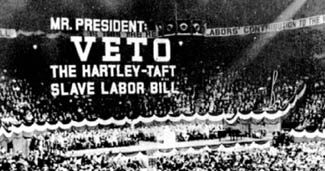
Passed Both Houses of Congress with Significant Majorities
Enacted over President Truman’s veto, the Labor Management Relations Act of 1947 (Taft‑Hartley) amended the Wagner Act of 1935 to address post‑war strikes and union abuses. Sponsored by Sen. Robert Taft (R‑Ohio) and Rep. Fred Hartley Jr. (R‑N.J.), the Act reaffirmed the right to organize but introduced major reforms:
- Banned Closed Shops: Employers could no longer hire only union members; union shops required majority approval.
- Defined Union Unfair Labor Practices: Added six prohibitions, including coercion, discrimination, secondary boycotts, and featherbedding.
- Authorized Right to Work Laws (Section 14(b)): Empowered states to protect workers from compulsory union dues — but did not extend that freedom to all Americans.
- Imposed Good‑Faith Bargaining Duties: Applied equally to unions and employers.
- Created National Emergency Strike Provisions: Allowed presidential injunctions and cooling‑off periods for strikes threatening national safety.
- Unions could now be held responsible for the damages they caused.
- Enhanced Transparency and Free Speech: Required union financial reporting and affirmed employer speech rights.
- Reorganized the NLRB: Expanded membership and created an independent General Counsel.
- Restricted Political Contributions: Barred direct union donations to federal campaigns.
Despite these advances, Taft‑Hartley stopped short of full worker freedom. By leaving monopoly bargaining untouched, it preserved unions’ power to speak for all employees — even those who reject union membership. And by making Right to Work optional at the state level, it created unequal protections across the country.
Historical Context
Passed after the 1946 elections, Taft‑Hartley reflected public frustration with widespread strikes. Supporters saw it as restoring equilibrium, yet it did not repeal the Wagner Act’s core protections — it partially refined them.
Enduring Impact
Nearly eight decades later, Taft‑Hartley remains foundational to U.S. labor relations. Its Right to Work authorization continues to empower workers in 26 states, but millions elsewhere remain subject to compulsory representation and dues. As proposals like the PRO Act seek to roll back these employee rights protections, the National Institute for Labor Relations Research continues to advocate for the expansion of employee freedom and justice through nationwide Right to Work and the ending of legal monopoly bargaining — ensuring every worker’s freedom of choice.