

Right to Work Benefits Fact Sheet – Spring 2026
Spring 2026 Right to Work Benefits Fact Sheet available online.
The National Institute for Labor Relations Research (NILRR) has released its new Spring 2026 Right to Work Benefits Fact Sheet, featuring the latest side-by-side economic comparisons between Right to Work states and Forced Unionism states.
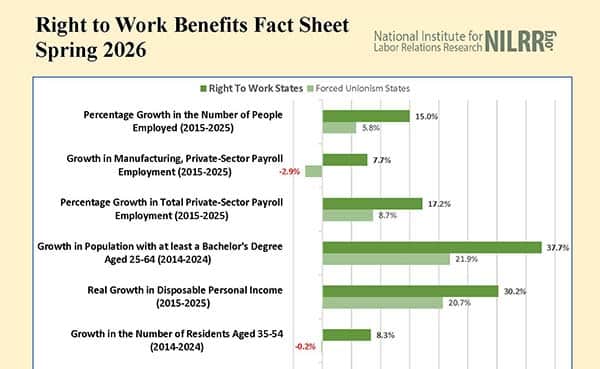
The data shows Right to Work states continuing to deliver stronger results across multiple key indicators (2015–2025):
- Employment growth in Right to Work states is 2.6 times greater than in Forced Unionism states
- Manufacturing payroll employment in Right to Work states is 3.7 times greater than in Forced Unionism states
- Total private-sector payroll employment in Right to Work states is 2 times greater than in Forced Unionism states
- Real growth in disposable personal income in Right to Work states is 1.5 times greater than in Forced Unionism states
- Growth in population ages 25–64 with at least a bachelor’s degree in Right to Work states is 1.7 times greater than in Forced Unionism states
Right to Work states also report:
- Higher cost-of-living-adjusted per capita disposable income ($65,746 vs. $62,251)
- Significantly lower unfunded public pension liabilities per capita (over $12,000 per person less)
- Fewer welfare (TANF) recipients per 1,000 residents (7.9 per 1,000 residents fewer)
- More new privately-owned single-unit housing authorizations per 1,000 residents (2.5 per 1,000 residents more)
Download the full two-page fact sheet PDF to view all charts.