
The Dark Foundations of American Labor Law: Government-Sanctioned Union Monopoly and Coercion
The NLRA, commonly known as the Wagner Act, stands as one of the most transformative—and destructive—pieces of New Deal legislation. Enacted in 1935 amid economic crisis, it granted labor unions government-backed monopoly power through exclusive representation and opened the door to compulsory unionism. Rather than fostering voluntary cooperation between free individuals, it created state-enforced cartels that override personal choice and subordinate constitutional liberties to collective power.
Sylvester Petro (1917–2007), the distinguished NYU and Wake Forest law professor, delivered the most incisive, constitutionally grounded critique of this system across key works: The Labor Policy of the Free Society (1957), Power Unlimited: The Corruption of Union Leadership (1959), and The Kohler Strike: Union Violence and Administrative Law (1961). Petro’s arguments are rooted in a fundamental principle: labor relations are not a special field exempt from the general rules of a free society. Private property, freedom of contract, voluntary association, individual liberty, and equal application of common-law rules must apply equally to unions, workers, and employers.
Petro’s Central Thesis and Common Law Theory
At the heart of Petro’s scholarship is his common law theory of labor relations. He argued that labor disputes should be governed by the same neutral, time-tested principles of the Anglo-American common law that apply to all other areas of human interaction. Under this framework, courts enforce consensual contractual arrangements, protect private property rights, uphold freedom of contract and association (including the right not to associate), and prohibit coercion, violence, intimidation, and fraud—without granting special immunities or privileges to any group.
Petro emphasized that the common law developed over centuries as an “extraordinary instrument of reason.” It treated unions as voluntary associations, not privileged cartels. Courts historically enjoined only unlawful conduct—such as blocking access to workplaces, physical violence, or secondary boycotts that violated others’ rights—while preserving the employer’s right to hire or fire based on union membership, the worker’s right to cross picket lines, and the union’s right to strike peacefully. No administrative bureaucracy like the NLRB was needed; impartial judges applying general tort, contract, and property law sufficed.
This common law approach stands in stark contrast to the NLRA’s administrative regime, which Petro viewed as a politicized departure from liberty. The Act substitutes majority-rule monopoly, mandatory “good-faith” bargaining, and tolerance for coercive tactics in place of voluntary consent and equal justice under law. Petro insisted that true labor reform requires repealing the NLRA’s special privileges and returning to common-law principles—where unions must persuade rather than coerce, and all parties operate under the same rules.
Detailed Arguments Against NLRA Monopoly Control
Petro systematically dismantled the NLRA’s majority-rule and exclusive-representation provisions as the root of all subsequent evils. Once a union wins certification—even by a slim or coerced majority—it becomes the exclusive bargaining agent for every employee in the unit, supporters and dissenters alike, often in perpetuity. This is not democracy; it is a state-enforced monopoly. Dissenting workers lose their fundamental rights to bargain individually, to associate (or refrain from associating) voluntarily, and to exercise personal agency. Petro called this “coercive and undemocratic,” noting that workplace representation bears no resemblance to legitimate political majoritarianism—it strips individuals of their natural right to refrain from collective action.
This monopoly power flows directly into compulsory unionism. Petro eviscerated the “free rider” fallacy: workers who refuse to join or pay dues are not freeloading—they are exercising their constitutional right to withhold financial support and association from an organization they reject. Forced dues or fees siphon wages for political and ideological causes many oppose, constituting compelled speech and association in violation of the First Amendment (principles later vindicated in Beck, Janus, and related cases). Petro warned that such coercion turns workers into revenue sources rather than free agents and breeds the corruption and violence documented in the McClellan hearings.
Labor union boss power grabs have essentially come from the barrel of a gun. As Chairman Mao famously declared, “political power grows out of the barrel of a gun”—a view quoted approvingly by Obama administration Manufacturing Czar Ron Bloom in a 2008 speech to union leaders: “We kind of agree with Mao that political power comes largely from the barrel of a gun.” The NLRA’s framework does not merely tolerate coercion—it empowers and protects it.
The Kohler Strike: Petro’s Definitive Case Study in Union Terror and NLRB Abuse
The six-year UAW strike against Kohler Company (1954–1960) serves as Petro’s master class in the real-world consequences of NLRA monopoly. Kohler was a model employer—high wages, generous benefits, and strong employee loyalty. The strike erupted primarily over the UAW’s insistence on compulsory “union security”—forced membership or dues for all employees. Kohler offered voluntary check-off but refused to impose affiliation on dissenters.
Petro documented over 400 incidents of union-orchestrated violence and intimidation: beatings (including broken ribs and hospitalizations), vandalism (acid on cars, sugar in gas tanks, paint bombs), mob home demonstrations of 400–700 people, poisoned livestock, and employment-office blockades. Non-strikers and replacement workers exercising their right to work were branded “scabs” and targeted.
The Clayboat Riot (July 5, 1955): 500–600 UAW picketers blocked unloading of English ball clay at Sheboygan harbor. Contractors were pulled from trucks and beaten. Equipment was sabotaged, causing thousands in damage. Police lost control. This secondary boycott pressure was enabled by the union’s monopoly power to starve the employer of supplies.
The NLRB’s 1960 ruling (Kohler Company, 128 N.L.R.B. 1065) exemplified administrative tyranny. It seized on minor employer actions to convert the economic strike into an unfair-labor-practice strike, ordering reinstatement of strikers with back pay—potentially displacing replacement workers—while largely downplaying union violence. Petro called the NLRB a politicized “kangaroo court” that chills employer speech under Section 8(a)(1) and undermines property rights by shielding obstructive picketing.
Taft-Hartley: Partial Reform, Enduring Evils
The 1947 Taft-Hartley Act offered modest corrections—Section 14(b) enabling Right-to-Work laws (now protecting workers in 26 states plus Guam), bans on closed shops, union unfair labor practices, and employer free-speech protections. Yet Petro showed how the NLRB undermined these reforms. The core monopoly of exclusive representation and compulsory bargaining remained, allowing ongoing violations of individual rights.
The Indivisibility of Constitutional Liberties
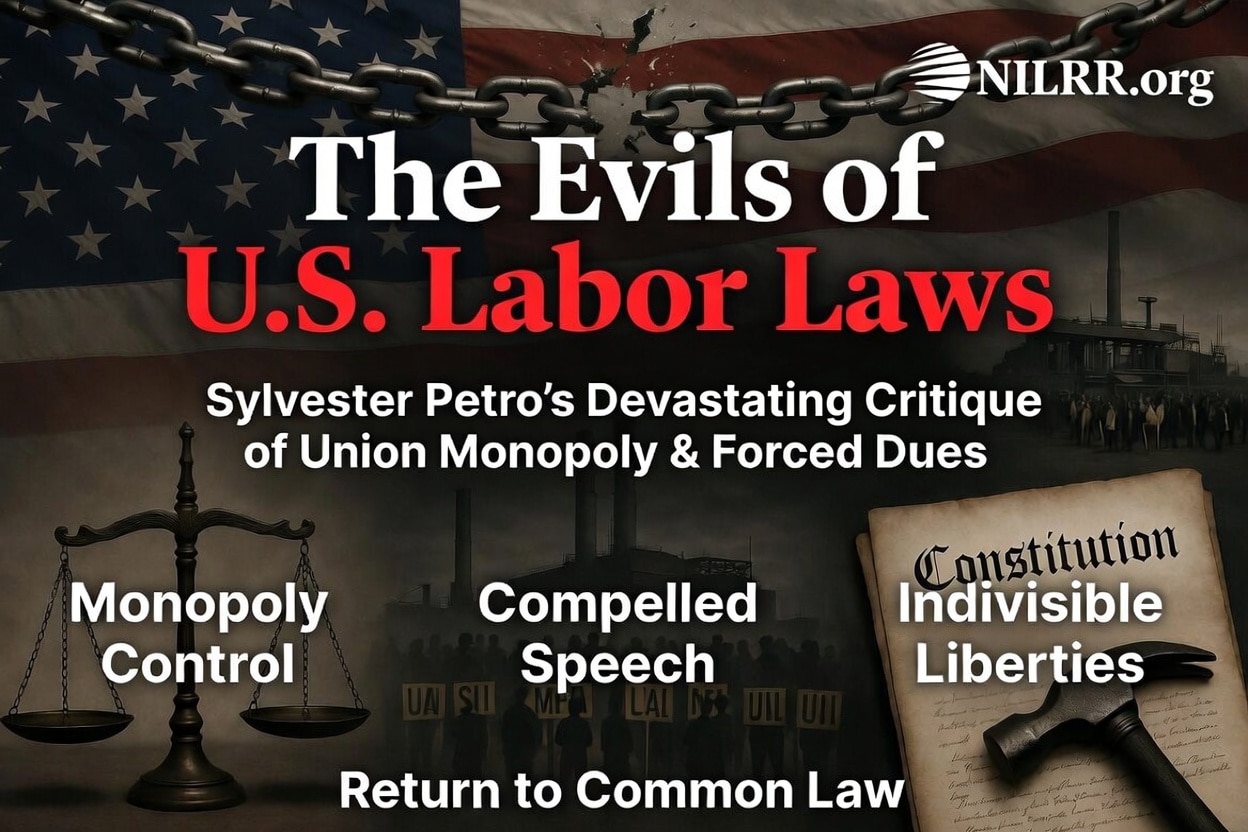
Petro’s theories rest on this bedrock: constitutional liberties are indivisible. There is no acceptable amount—not even a little bit—of loss of individual freedoms. Any government grant of monopoly power that overrides a single worker’s rights to speech, association, and agency necessarily erodes the rights of all. Partial measures like Taft-Hartley merely tolerate the cancer. Compromising on compulsory unionism or exclusive representation fractures the entire framework of a free society.
Petro’s Remedies and Call for Genuine Reform
Consistent with his common law theory, Petro’s solutions remain urgent: repeal the NLRA’s most illiberal features (exclusive representation, duty to bargain, tolerance for compulsory unionism); abolish the NLRB; return all labor disputes to impartial constitutional courts under ordinary common-law rules of contract, tort, and property; and enact nationwide Right-to-Work protections to eliminate forced dues. Only voluntary association, disciplined by common law, can restore true worker choice and harmonious relations.
At the National Institute for Labor Relations Research (NILRR.org), our research archive confirms that these monopoly-control and forced-dues schemes continue to empower and embolden union officials, while undermining working Americans’ constitutional rights and liberties. The evils of U.S. labor law are not relics of the past—they continue daily assaults on freedom today.
Petro’s books and papers provide the intellectual and legal foundation for real labor policy reform grounded in common-law liberty and harmonious with the U.S. Constitution.
For the full texts of Petro’s works, detailed case studies, and our ongoing documentation, visit NILRR.org.
Footnotes
- Sylvester Petro, The Labor Policy of the Free Society (New York: Ronald Press, 1957).
- Ibid.
- Sylvester Petro, The Kohler Strike: Union Violence and Administrative Law (Belmont, Mass.: Western Islands, 1961).
- Ron Bloom, speech to Union League Club of New York (Feb. 2008).
- Sylvester Petro, Power Unlimited: The Corruption of Union Leadership (1959).