
Longshore Local Asks Third Circuit to Overturn NLRB Blacklisting Finding
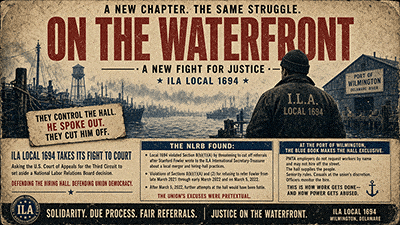
ILA Local 1694 has asked the U.S. Court of Appeals for the Third Circuit to set aside a National Labor Relations Board decision holding that the local unlawfully used its exclusive hiring hall at the Port of Wilmington to punish a longshoreman for internal dissent.
In April 2026, the Board (Chairman Murphy and Members Prouty and Mayer) adopted most of an administrative law judge’s findings and went further on one key point. It found that Local 1694 violated Section 8(b)(1)(A) by threatening to cut off referrals after Stanford Fowler wrote to the ILA International Secretary-Treasurer about a local merger and hiring-hall practices. It also found violations of Sections 8(b)(1)(A) and (2) for refusing to refer Fowler from late March 2021 through early March 2022 and on March 5, 2022. The Board reversed the judge on the period after March 5, concluding that Fowler reasonably believed further attempts at the hall would be futile.
At the Port of Wilmington, three “Deep-Sea” ILA locals, including Local 1694, operate under the Blue Book agreement with the Ports of Delaware River Marine Trade Association. That contract makes the hall exclusive: PMTA employers do not request workers by name and may not hire replacements or fill-ins off the street. They list the ships and the number of workers needed; the hall supplies the people.
A worker who wants a job that day must first call the hiring line the night before, then appear at Local 1694’s hall on South Claymont Street, scan a PMTA-ILA identification card, and receive a time-stamped yellow registration slip from the PMTA dispatcher. Gang bosses then fill openings. Workers in the Basic Unit and Secondary Workforce must follow seniority. Once those lists are exhausted, they may select Registered Casuals—and here they have discretion. They may “cherry pick” any qualified casual they want.
Union officers monitor the daily hire. In Fowler’s case, the record showed President Ashe stepping in at the exact moment a gang boss was about to choose him, directing the boss to pick someone else and telling Fowler to go “to his side”—the former Local 1694-1 warehouse operation known as the Hut. The union later argued it was merely enforcing the Blue Book’s Craft Interchange Agreement. The Board found that the explanation was pretextual: the agreement had not been applied to former 1694-1 members, and officials had already told Fowler that the real reason was the letter he had sent to the International.
Because the hall was exclusive, those interventions did more than express disapproval. They determined whether Fowler worked that day. After enough such episodes, the Board concluded that a reasonable worker would treat further attempts at the hall as futile.
The Board ordered the local to cease the threats and discriminatory referrals, notify Fowler in writing that referrals are available, make him whole for lost earnings and other pecuniary harms, and expunge related records. Local 1694 petitioned for review on April 15, 2026 (3d Cir. No. 26-1872). Fowler later successfully moved to intervene in the appeal.
The case now asks the Third Circuit whether the Board correctly applied the duty of fair representation and the futility principle to an exclusive hiring hall that a worker reasonably viewed as closed to him because he had complained upward.
Stanford Fowler, as an intervenor, is represented by Glenn M. Taubman and Bernard Zamaninia of the National Right to Work Legal Defense Foundation Inc.