

Right to Work Laws Are Reshaping Economic Competitiveness
Right-to-Work laws prohibit mandatory union dues, altering how unions collect revenue and exercise bargaining power. LegalClarity’s analysis shows these laws create a split labor market, with differences in wages, job growth, and business investment across states. For advocates, understanding these economic impacts is essential for framing arguments about competitiveness, workforce mobility, and the broader consequences of labor policy.
Job Growth and Income Trends
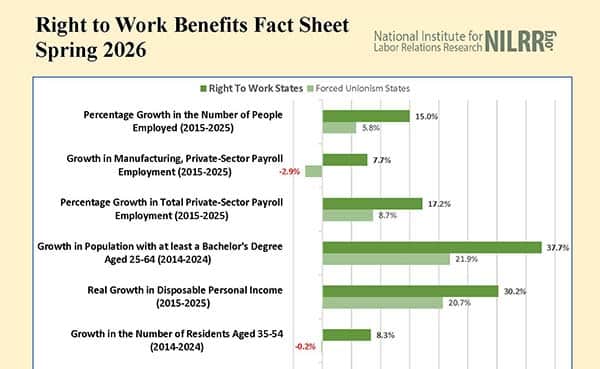
Recent data show that Right to Work states consistently outperform forced-unionism states in employment and income growth. According to the National Institute for Labor Relations Research, between 2014 and 2024, Right-to-Work states saw faster job creation, stronger manufacturing expansion, and higher real disposable incomes. These states also attracted more residents, particularly working-age adults and families, contributing to population growth and consumer spending. By contrast, states without such laws experienced slower economic momentum and higher reliance on welfare programs. (See NILRR.org Right to Work Benefits Fact Sheet Winter 2026)
Business Investment and Competitiveness
Independent studies highlight that business investment flows more readily into Right-to-Work states. The Virginia Chamber of Commerce reports that Virginia’s long-standing law has helped secure its position as a top state for business, with significant gains in new company formation and private-sector employment. Projections suggest that repealing the law could reduce Virginia’s Gross State Product by nearly $36.8 billion and cost more than 180,000 jobs over a decade. These findings underscore how labor policy directly influences competitiveness and long-term economic strategy. (Source: Virginia Chamber of Commerce: Right to Work Powers Virginia’s Jobs and Wage Growth)
Wage Outcomes and Worker Mobility
While labor union-financed critics argue that Right to Work laws weaken unions and suppress wages, recent analysis shows nuanced outcomes. The Virginia Chamber study found that average annual wages in manufacturing and construction could be $3,000–$5,000 lower in the absence of Right to Work protections. Moreover, migration patterns reveal that workers are voting with their feet: over the past 14 years, Right to Work states gained 7.2 million residents, while non-Right to Work states lost 7.1 million. This suggests that workforce mobility is strongly tied to perceived opportunity in states with these laws. (Source: Virginia Chamber of Commerce: Right to Work Powers Virginia’s Jobs and Wage Growth.)
Policy Divides and Future Outlook
The repeal of Michigan’s Right to Work law in 2023 illustrates the ongoing policy divide. While some states roll back these laws to strengthen union bargaining power, others maintain them to attract investment and workers. Analysts note that the split labor market created by these policies will continue to shape regional competitiveness, wage dynamics, and political debates. For advocates and policymakers, the challenge lies in balancing labor union protections with economic growth imperatives, a tension that remains central to the future of U.S. labor policy. (Source: NILRR.org Virginia: Learn From Michigan’s Horrendous Mistake)